 12th District Commander Larry Levy, a disabled veteran, understands the camaraderie offered by the VFW. Photo by Kate Stow
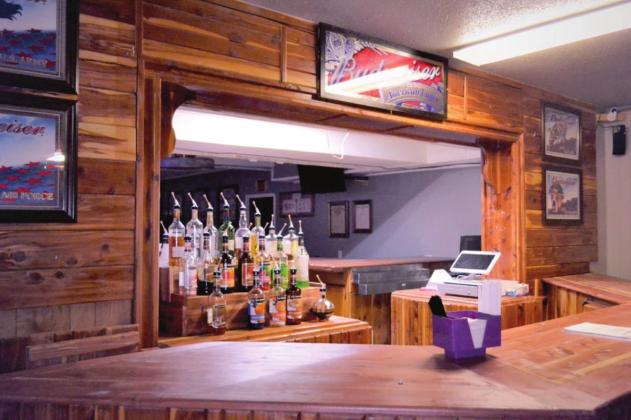 The handmade bar at the Linden VFW could be gone soon if Governor Greg Abbott refuses to address the effects of the pandemic on Texas VFW Posts. Photo by Kate Stow
 Larry Levy counts fellow veteran Caleb Goebel as one of the VFW members that helped save his life. Photo by Kate Stow
VFW strives to ‘leave no man behind’
In 2017 a veteran suicide report shocked the country by declaring that about 20 veterans commit suicide every day. That study was based on data collected between 2005 and 2017.
Those years encompass the deployment and return of troops from Iraq and Afghanistan in the wake of 9/11. During those years 78,875 veterans took their own lives - more than the number of Americans killed in each major conflict except for World War II and the Civil War.
Explanations have pointed to post-traumatic stress disorder, misuse of medication, traumatic brain injuries, financial issues, family problems, military sex assault and combat experiences. Sometimes, just leaving a military environment can cause major depression in veterans.
“When service members leave the military, they leave a team-first culture that has a very clear mission, recognizable symbols of status and achievement, and more than 240 years of history and culture,” said Joe Plenzler, communications director for the nonprofit Wounded Warrior Project in an interview with Stars and Stripes magazine earlier this year.
A “sense of tribe” is critical for high-risk veterans, and the Veterans of Foreign Wars (VFW) was organized in 1899 just for that purpose. Today, there are 2.4 million members located in 8,500 VFW posts around the world.
In Texas there are over 72,000 members in 306 Posts throughout the state. Cass County has two posts: 5870 Queen City Memorial Post and 6968 Lyles-McDaniel Post in Linden. Both are in the 12th District, Commanded by Larry Levy of New Boston.
“The image of the typical VFW is that of older men sitting around trading war stories,” said Levy. “But since 9/11 that’s changed a lot. It’s a lot of younger men, just like me, who need the camaraderie of battle buddies.”
Levy knows all too well what that camaraderie means to a combat vet of two Iraqi tours with a TBI and PTSD. Two years ago, he found himself in a dark place. “The VFW saved me,” he said. “I don’t want to think about what could have happened if I didn’t have that group of guys.”
The first-hand knowledge of the healing power of the VFW is why the posts in Texas are upset with Governor Gregg Abbott. In June, Abbott signed an order which closed bars and establishments that operate with more than half of the income coming from alcohol sales. This includes most of the Texas posts.
State Commander Richard Shawver has written two letters to the Governor, dated July 1, 2020, and August 19, 2020. Both letters are concerning the nonessential status of the VFW Posts during the pandemic.
“We feel, as a department, that Abbott has ignored the veterans,” Levy explained. “How can they say that a hair or nail salon, or a gym, or a tanning salon, or massage parlor, or nursing home can be open as essential, but businesses who are here, like us – we are a veterans service organization – cannot open.”
The letter dated July 1 reads, in part: “This last year alone these members completed 154,456 voluntary community service projects for a total of 167,622 hours driving over 582,234 miles for a total benefit to Texas communities of $4,193,280.42 according to the Internal Revenue Service. They also donated another $1,862,946.00 to organizations within these communities and of import-ant note are the 8,925 Texas students that participated in our youth scholarship programs that we awarded over $318,788.00 for college scholarships.”
One of the main veteran services the VFW provides is a no cost Service Officer/Veteran Advocate Program for Texas veterans to ensure all entitlements and benefits earned are awarded. They work closely with the Texas Veterans Commission to ensure that every Texas veteran is taken care of ranging from disability claims, job training and employment to education benefits.
That help is paramount for veterans in small rural areas where the VFW is the closest place where they can find anyone that remotely understands their disabilities and can help them file the necessary paperwork to receive monthly payments.
Abbott, who is wheelchair bound, became permanently disabled when a tree fell on him while he was jogging in 1984. After suing the homeowner and a tree service, he received a hefty insurance settlement that includes a monthly payment for life. In 2013 he revealed the amount of that payment was $14,400 and increases by 4% a year.
That irony is not lost on the 432,731 disabled veterans currently living in Texas. On top of everything else, the prolonged pandemic is another stress factor weighing on the soldiers like an overstuffed rucksack in the desert heat.
So far this year there have been 2,500 veteran deaths from COVID-19. One study says that with increased social isolation and higher veteran unemployment, 550 additional veterans beyond the projected 20 per day are expected to take their own lives within the next year.
A number of interventions have been found to be useful in fighting COVID-19 and veteran suicide even though a cure remains elusive. For veterans, this includes timely access to the treatment of an underlying disorder, whether that is depression, PTSD, substance abuse, chronic pain or other conditions.
Several studies have proven that peer support and participation in activities with other veterans can have a lifesaving impact. Emotional support dogs can even make a big difference in a veteran’s life – another service offered by the VFW. Since implementing the donation program, the Texas posts have paid for training and placement of dozens of these animals and have over 1,000 names on a waiting list.
“VFW Posts must reopen to continue to serve the needs of our members, all Texas veterans, their families, dependents and survivors. Unfortunately, because many of our facilities are licensed by the TABC, these facilities remain closed,” said Dan West, State Adjutant/Quartermaster for Texas’ Veterans of Foreign Wars (VFW) in a press release dated September 23, 2020. “We’ve offered to comply with the suspension of alcoholic beverage sales, but our requests have been ignored. It’s a travesty, frankly, that those who served our nation and their families are shut off from the critical services we provide,” added West.
“Veterans like to be together, we need each other because we are the only ones who can relate to what we have all been through,” exclaimed Levy. “When you shut down a post home, where do we go? We isolate because we can’t go anywhere.”
The VFW has petitioned the Governor’s Office to reopen VFW Posts, keeping TABC portions of these facilities closed, and ensuring compliance with all State-ordered social distancing and occupancy regulations that govern other establishments. “We’ve heard nothing from Gov. Abbott or state leaders,” said West. “Our only option may be to voluntarily surrender our TABC licenses, but there is a long-term cost and consequence to doing so that may be too great for many of our VFW posts to shoulder. The more than 1.7 million veterans in Texas deserve better.”