

 George on tractor (present generation)
 Granddaughter sowing seeds (future generation)
 Oldest daughter in melon patch (childhood on farm)
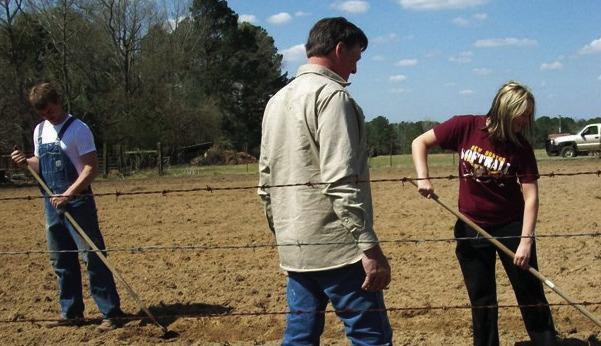 George with Parker & Molly Kate planting (2010) (family teaching moment)
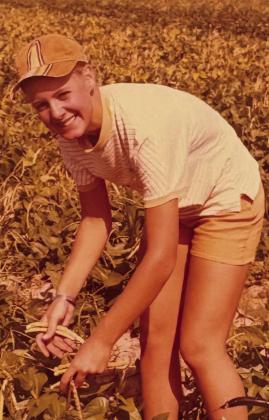 Carmen picking peas (past generation)
ROOTED in Cass
Part 3 of a 3-Part Series
As the Rooted in Cass series on the Echols family comes to a close, one truth becomes abundantly clear: the story of Cass County is deeply connected to the land, and to the families who have cared for it across generations.
For the Echols family, farming has never simply been about crops or harvests. It has been about stewardship, tradition, and passing knowledge from one generation to the next.
George Echols knows this well. A lifelong farmer in the Kildare area, George’s connection to the land began almost as soon as he could walk. In fact, some of his earliest memories go back to when he was just three years old.
“My earliest memory of working on the family farm was when I was three years old,” he recalled. “My dad, Bert, let me ride bareback on the horse while it pulled the plow in the corn field. I would sit behind the horse’s collar and hold on to the hames.”
Those early experiences were more than childhood adventures. They were the beginning of a lifelong education in farming, one that came directly from his parents, Bert and Carmen Echols, who themselves came from farming families and believed that raising their seven children on the land would instill both responsibility and appreciation for hard work.
George remembers the practical wisdom his parents shared, lessons learned through years of experience working the soil.
“They taught me to make sure the ground was dry enough before plowing,” George explained. “If it was too wet and you plowed, the bacteria in the soil would die and crops would not grow as well.”
Timing, he says, was everything, not just in planting, but in harvesting as well.
“If you waited too long, the vegetables would be too tough to eat. If you picked peas too early, the pods would not be full.”
Farming itself has changed significantly since George’s early years. In those days, horses pulled the plow while the farmer walked behind, guiding it carefully through the rows.
Today, tractors have replaced much of that labor, allowing fields to be worked more quickly and efficiently. Even hay baling has evolved.
“When I was young, horses pulled the plow as the farmer walked behind to guide it in the rows,” George said. “Today plowing is done with a tractor and can be done much more quickly. Round bales of hay have mostly replaced the small square bales.” Yet despite these advancements, many traditions have remained firmly rooted. One crop in particular holds special memories for the Echols family: peas. “Peas were a very important crop to our family since I had lots of sisters who could help pick and shell them,” George shared with a smile. “Our goal was 52-quart bags, so we could have peas and cornbread every week.”
Family labor has always been part of the farm’s rhythm. Over the years, that tradition has continued with George’s own children and grandchildren.
“They have helped hoe, plant, fertilize, pick and sell crops,” he said. “One year the grandkids sold enough melons to buy their new school clothes.”
Moments like those illustrate the quiet beauty of generational farming: the land teaches lessons that go far beyond agriculture.
One especially meaningful memory occurred when George and his son Parker planted melons on a field his father had used decades earlier.
“A few years ago, my son Parker and I grew melons on the same plot my dad had planted them on fifty years ago,” he said. “I like the idea that three generations used the land.”
Passing those fields today still brings back memories. Perhaps some of the most cherished traditions come from George’s father, Bert Echols, whose wisdom was both practical and memorable.
“Dad always said to plant melons, cantaloupes, and garden plants on Good Friday,” George recalled.
The family still follows planting schedules written years ago by Bert himself, carefully charted recommendations for when certain crops should go into the ground.
But Bert’s advice was not always written in charts. Sometimes it came in colorful sayings that local farmers still remember.
George shared one of his father’s favorite pieces of advice: “Wait till you hear the whippoorwills sing from an open window, then kick your covers off the foot of the bed and plant your okra.”
Beyond family wisdom, George also credits the broader farming community in Cass County for shaping his approach to agriculture.
“I listened to the older, experienced farmers in our community about how, what and when to plant,” he explained. “They would also tell me what not to do since they had already tried it and knew it was not a good plan.”
That exchange of knowledge, neighbors helping neighbors, has long been part of rural life. Looking toward the future, George hopes those traditions will continue.
“I hope farmers in Cass County will continue to have gardens and field crops and be willing to share their harvests with others,” he said. “Sharing with older folks and neighbors leads to better communities.”
It is a sentiment that perfectly reflects the spirit of the Echols family, a family whose roots in Cass County stretch back generations and whose values of hard work, stewardship, and community remain firmly planted.
More than 175 years have passed since Elijah Pennington Echols first made his way to the Kildare area in 1848. What began as a new beginning for one family has grown into a living legacy carried forward by generations who have worked the soil, raised their families, and served their neighbors. Today, as George Echols continues tending the land that shaped his upbringing, the story of the Echols family reminds us that the roots of Cass County are not only found in the soil, but in the families who have cared for it generation after generation.
As this three-part series concludes, it is impossible not to feel a deep sense of gratitude for families like the Echols who have helped shape the character of this region.
Their story is more than a family history. It is part of the living heritage of Cass County. And it is exactly the kind of story that Rooted in Cass hopes to continue telling.
If your family has deep roots in Cass County and stories that deserve to be remembered, I would be honored to help share them so that together we can continue preserving the living history of our community.
Rooted in Cass is a continuing series by columnist Niccqueta Varmall dedicated to preserving the families and stories that helped shape Cass County.
Because every family has roots, and together they grow the story of Cass County.