


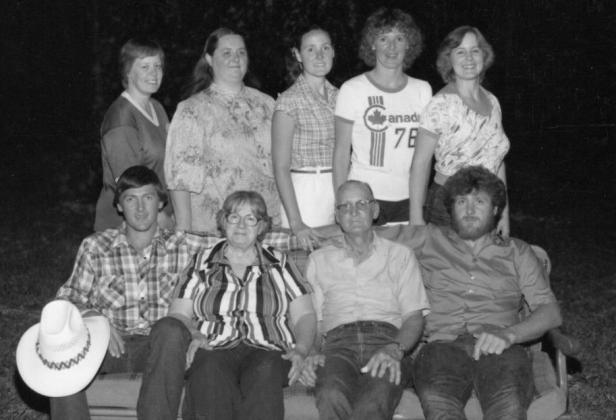
 Bert Echols family.
 Bert Echols in the cornfield 1950.
 George W.Thrower in 1918.
 Parker in the cornfield.
 George Echols with the grandkids.
 Mama and Papa in 1933.
ROOTED in Cass
n
Arrival and the Roots
Part I of a 3-Part Series
Some stories begin in archives. Others begin across a table.
This one began during a conversation with Larry Allen, president of the Kildare Community Center. When discussing families whose roots run deep in Cass County soil, he paused and said plainly, “You need to talk to the Echols family.”
He wasn’t suggesting a feature. He was pointing toward history.
That recommendation led me to Ms. Mary Echols, scrapbooker, library volunteer, keeper of photographs, and memory-bearer for a family whose presence in the Kildare area reaches back to 1848. As she began sharing, the dates came first. But the life came after.
The Arrival
Family records confirm that Elijah Pennington Echols (1823–1899) arrived in Cass County near Atlanta, Texas area in 1848. East Texas was still forming its identity. Roads were limited. Communities were scattered. Survival depended on work, faith, and endurance.
Elijah did not simply pass through. He settled. From him came generations who would remain anchored in Cass County soil.
His son, Sylvanus Walter Echols, was born January 25, 1873, on a farm west of Atlanta, Texas. Farming was not an occupation he chose later; it was the environment into which he was born.
On November 10, 1895, Sylvanus married Eva Alzena Thomas, born March 26, 1876, near Stone Mountain, Georgia. She came from farming stock herself, the daughter of John Walter Thomas and Susan Frances Meadows. Their union strengthened two agricultural legacies.
They first lived near the Roach community west of Atlanta. After the death of his father, Sylvanus purchased portions of family land from his siblings in 1900, a decision that strengthened the Echols agricultural presence in the area.
However, the land on which the family lives today traces through the maternal line. In 1894, Lewis Thrower came to Kildare. Later, he and his son George Thrower purchased land in the area, land that remains in the family to this day.
The Echols and Thrower families, both rooted in farming traditions, became permanently interwoven through marriage. Through the Thrower line, the soil itself became inheritance, not just property, but continuity.
In 1905, the family moved to the Lewis Community near Kildare Junction and built a log home. There, they farmed. They operated a syrup mill, producing ribbon cane syrup. Sylvanus did construction work and later became a Pentecostal preacher. Eva was remembered as both an outstanding homemaker and a capable farmer.
Their home was not merely a shelter. It was an enterprise, worship, and training ground.
A Farm Chosen on Purpose
Generations earlier, Elijah Pennington Echols had settled the land. But for Mary and her siblings, the shaping hands were their parents, O.B. (Bert) Echols and Carmen Thrower Echols.
Both came from farming families themselves. Agriculture was familiar, inherited, understood. Yet choosing to remain on a farm was still a decision.
They decided that living on a farm would be the best place to raise a family. Not because it was easy.
But because it formed character. Bert farmed and later became a master carpenter. Carmen continued to grow flowers long after retirement, known for her steady green thumb. Together, they built a household rooted in work, faith, and responsibility.
Seven children were raised under their care: Beth, Nan, Grady, Mary, Fay, Gayle, and George. Seven sets of hands.
Seven sets of footsteps across East Texas soil. On that farm, chores were shared. Food was grown. Meals were built from what they harvested. Canning jars lined shelves. Crops rotated through seasons. And children learned early that participation was expected.
It was not simply a place to live. It was a place to learn how to live. That choice, to raise children on working land, shaped everything that followed.
Work Was Not Optional
As Ms. Mary spoke, her voice shifted from historical record to lived memory. “Producing our own food was actually a necessity,” she said.
Not a hobby. Not nostalgia. Necessity. Crops were planted, hoed, harvested, and stored. Cattle provided milk and meat. Chickens were tended for eggs and meat. Hogs were raised. Horses pulled plows and wagons.
Children helped with fertilizing, planting, hoeing, harvesting, and storing both garden and field crops. Nan and George handled milking. Others gathered eggs or helped with slaughtering chickens. Farm work came before or after school and church. Responsibility was shared.
Yet even in discipline, there were moments of sweetness. Family members gathered wild grapes, muscadines, mayhaws, peaches, figs, pears, plums, persimmons, pecans, black walnuts, blackberries, and dewberries. “We couldn’t resist eating some as we picked the fruit,” she recalled. Food was sustenance. It was also a joy.
The Watermelon Stand
One memory surfaced with particular clarity. As little girls, she and her sisters set up a roadside watermelon stand along the farm-to-market road. They hauled the melons themselves — large, heavy watermelons grown in Cass County soil. You had to lean into the lift. You had to brace your legs. You had to carry the weight carefully so it wouldn’t slip from your hands.
They stacked them neatly and waited for passing motorists. Cars would slow. Some would stop. Some would not. But one customer never failed.
“The mailman,” she said, smiling at the memory. “He stopped every day.” Every day.
He would pull over during his route and buy a watermelon from the girls. She said she always thought that was the sweetest thing, not just because he bought one, but because he made it part of his routine. A quiet encouragement. A steady kindness.
Others purchased too. The stand was real work. It helped the family economy. It taught responsibility.
But the mailman who stopped daily stayed with her. There is something profound in that small act, a rural mail carrier supporting young girls trying to sell what their family had grown. No ceremony. No applause. Just consistency. That memory, she admitted, had not surfaced in some time. But as she told it, it warmed her heart.
And hearing it, it warmed mine too.
Recognition in the Fields
The family’s agricultural excellence did not go unnoticed. A 1950 article in the Marshall News Messenger highlighted O.B. Echols was one of several East Texas farmers utilizing advanced corn-growing methods. That year, he estimated yields averaging approximately 80 bushels per acre, with some acres expected to produce over 100.
Later that same year, the Citizens Journal reported O.B. Echols placed second in the county corn contest, producing 75½ bushels per acre. His name appeared alongside other East Texas growers at a banquet hosted by the Atlanta National Bank.
Those newspaper clippings remain preserved in family scrapbooks. Because in the Echols family, farming was not just survival. It was an achievement.
Preserving What Matters
Ms. Mary’s scrapbooks hold more than photographs. They hold continuity. Images of corn patches in 1950.
Watermelons stacked high in pickup beds. Children perched atop harvest piles.
Rows of tall green corn under the wide Texas sky. Now, as a volunteer at the local library, she continues the instinct to preserve. She safeguards community knowledge the same way her family once safeguarded harvest. The rhythm is familiar. Plant, harvest, store, preserve.
The land shaped that instinct.
A Table Built From the Soil
Meals reflected what the fields produced: purple hull peas, cream peas, crowder peas, sweet potatoes, watermelons, cantaloupes, corn, tomatoes, squash, mustard greens, butter beans, okra, onions, cabbage, and more.
Surplus produce was canned for winter months. Jams and jellies were prepared. Biscuits were baked. Watermelon breaks were allowed on long mornings in the fields.
The food was practical. But it also bound generations together. Even as cotton eventually gave way to edible crops, even as carpentry and other trades supplemented farm income, the soil remained central to the Echols identity.
Some members of the younger generations still garden. Others continue serious farming operations today, particularly with watermelons, cantaloupes, and peas.
The legacy is visible in fields. It is tasted at the table.
Roots That Stayed
Many families came to East Texas in the 1800s. Not all remained.
The arrival of Elijah Pennington Echols in 1848 marked the beginning of a name that would not lift from Cass County soil. Through wars, economic shifts, changing agricultural practices, and modern transitions, the Echols family remained anchored.
As Larry Allen observed when suggesting this story, certain families become woven into the identity of a community. Their presence is not loud, it is steady.
The Echols story is not only about acreage or bushels. It is about endurance.
It is about lifting watermelons with your sisters. It is about clipping newspaper articles because someone in the family did something worth remembering.
It is about land that feeds you and shapes you. In Part II of this series, we will explore how these agricultural roots expanded into deeper service in church life, community leadership, and civic involvement throughout Kildare and beyond.
But for now, it is enough to understand this: In 1848, a man arrived.
He planted himself. And the roots never left.