
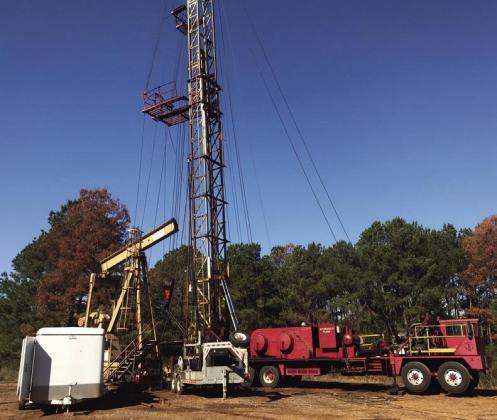
 1 Standard Lithium Ltd.,a leading near-commercial lithium company,announced in a Press Release,March 28,2023,results from brine test samples from its work in two test wells in the Smackover just north of Mcleod.The illustration shows where the wells are.
Two big lithium developments in area
Two lithium news-related stories have crossed the wires over the last few weeks. First, a U.S. Geological Survey-led study estimated between 5 and 19 million tons of lithium reserves are located beneath southwestern Arkansas on the border of Texas. It was also recently announced that “StartUp Junkie Consulting will support small businesses in leveraging Lithium for the clean energy and electric vehicle transition across Northeast Texas, Southern Arkansas, Northern Louisiana, and West Mississippi.”
Regarding the survey, the good news for the area is that they only sampled a small portion of the region. One of the companies trying to harvest the lithium in our area noticed that, when sampling Northeast Texas the area held some of the highest- grade lithium in the world. The study was done using a combination of water testing and machine learning. “If commer- cially recoverable, the amount of lithium present would meet projected 2030 world demand for lithium in car batteries nine times over,” notes a press release from the U.S. Geological Survey (USGS).
“The study’s novel methodology, carried out collaboratively by the USGS and the Arkansas Department of Energy and Environment’s Office of the State Geologist, made it possible to quantify the amount of lithium present in brines located in a geological unit known as the Smackover Formation. Extracting lithium from brines co-produced during oil and gas operations provides an opportunity to extract a valuable commodity from what would otherwise be considered a waste stream.”
“Lithium is a critical mineral for the energy transition, and the potential for increased U.S. production to replace imports has implications for employment, manufacturing and supply-chain resilience. This study illustrates the value of science in addressing economically important issues,” said David Applegate, USGS Director.
The press release went on to explain that “the Smackover Formation is a relic of an ancient sea that left an extensive, porous, and permeable limestone geologic unit that extends under parts of Arkansas, Louisiana, Texas, Alabama, Mississippi, and Florida. It dates to the Jurassic geological time-period which is known for its rich deposits of oil and bromine. In recent years, the Smackover Formation has also gained attention for potential lithium in brines—high-salinity waters associated with deep salt deposits.”
“Our research was able to estimate total lithium present in the southwestern portion of the Smackover in Arkansas for the first time. We estimate there is enough dissolved lithium present in that region to replace U.S. imports of lithium and more. It is important to caution that these estimates are an in-place assessment. We have not estimated what is technically recoverable based on newer methods to extract lithium from brines,” said Katherine Knierim, a hydrologist and the study’s principal researcher. “
Global demand for lithium, a critical mineral essential for battery production, has increased substantially in recent years.
This trend is projected to persist as the transition from fossil fuels to electric and hybrid vehicles intensifies, underscoring the mineral’s growing significance in energy technology advancements.
“The U.S. relies on imports for more than 25% of its lithium. The USGS estimates there is enough lithium brought to the surface in the oil and brine waste streams in southern Arkansas to cover current estimated U.S. lithium consumption. The low-end estimate of 5 million tons of lithium present in Smackover brines is also equivalent to more than nine times the International Energy Agency’s projection of global lithium demand for electric vehicles in 2030.
The USGS predictive model provides the first estimate of total lithium present in Smackover Formation brines in southern Arkansas, using machine learning, which is a type of artificial intelligence. Samples from Arkansas were analyzed by the USGS Brine Research Instrumentation and Experimental lab in Reston, VA, and then compared with data from historic samples within the USGS Produced Waters Database of water from hydrocarbon production. The machine learning model was then used to combine lithium concentrations in brines with geological data to create maps that predict total lithium concentrations across the region, even in areas lacking lithium samples.
It seems in preparation for the influx of new startups in this region regarding lithium production the SBA awarded Fayetteville-based Starup Junkie one of 14 New Awards for Regional Innovation Cluster Network to Drive Nationwide Small Business Growth, Job Creation and Innovation.
On a website from the US Small Business Administration & Startup Junkie (lithiumric.org) it describes its new Cluster as the the “Lithium Regional Innovation Cluster (LRIC) is a dynamic public-private collaborative initiative focused on accelerating energy innovation and the electric vehicle (EV) transition by strengthening the lithium value chain. The LRIC is one of the US SBA’s official distinguished and esteemed Regional Innovation Clusters.”
“At the LRIC, we are committed to enhancing national security by building a more resilient and sustainable lithium supply chain, crucial to powering the future of energy. Rooted in the rich lithium resources of the Smackover Formation, one of the largest lithium deposits globally, LRIC is positioned as a leader in the energy revolution.”
The same site describes its mission as “to support and foster innovation within the lithium value chain through partnerships, commercialization training and support, access to capital, and world-class expertise. Our efforts are centered on driving technological advancements and facilitating collaboration among key stakeholders, including small businesses, scalable ventures, enterprises, academia, scientists, engineers and innovators.
“Led by globally recognized entrepreneurial support organization, Startup Junkie, and funded by the US SBA, LRIC is dedicated to creating an inclusive and diverse ecosystem, supporting underserved communities, and promoting sustainable economic growth. Through our nocost, top-tier consulting services, world-class innovation and entrepreneurship programming, and key stakeholder coordination and collaboration we empower businesses and innovators to thrive in the emerging lithium economy.”
“Our selection to lead the LRIC is a testament to our commitment to fostering innovation and supporting the growth of small businesses,” said Jeff Amerine, Founder and Managing Director of Startup Junkie. “We are dedicated to leveraging this award to cultivate an ecosystem that not only enhances energy innovation but also drives economic development and resilience across the region.” - TalkBusiness.net Something to note on the site is that this county was one of four Texas counties at the epicenter of the Lithium RIC, that spans through four states.