
TWDB feasibility study on reservoir
With the recent announcement that the Texas Water Development Board will be conducting a feasibility study on the proposed Marvin Nichols Reservoir in the Sulphur River Basin of Northeast Texas, those opposed to the lake’s construction are now calling on landowners and the general public to voice their opinions on the project.
The feasibility study was mandated by the Texas Legislature in the spring of this year. Representative Gary VanDeaver, from New Boston, stepped up to ask for the study to be conducted. The study was set to include a 60-day comment period for those who would like their voice heard on the mammoth proposed lake. The comment period is set to run through December 1, 2023.
Rep. VanDeaver said at the time, “People in my District deserve the right to be heard by state leaders. Too often rural Texans are left behind while the spotlight shines on the needs of our large urban neighbors. I fought for the Legislature to include this important review, and I hope everyone will speak out about how the timeline, cost and economic impact of Marvin Nichols would impact them and our overall community.”
VanDeaver also stated, “Roughly 66,000 acres of private land would be used to build this reservoir, but at least an additional 130,000 acres of land [would be] taken out of production and out of private hands. This would make the proposed Marvin Nichols Reservoir one of the most expensive public works projects and one of the largest land grabs by eminent domain in Texas history.”
Texas Governor Gregg Abbott has also gone on record with his opposition to the massive land grab, stating, “...we must explore other options before we start taking people’s lands or flooding property that’s been around for literally centuries.”
The Marvin Nichols Reservoir has been a proposed water strategy by water planners in the Dallas area for years, just as long as it has been opposed by water planners in our area of Northeast Texas.
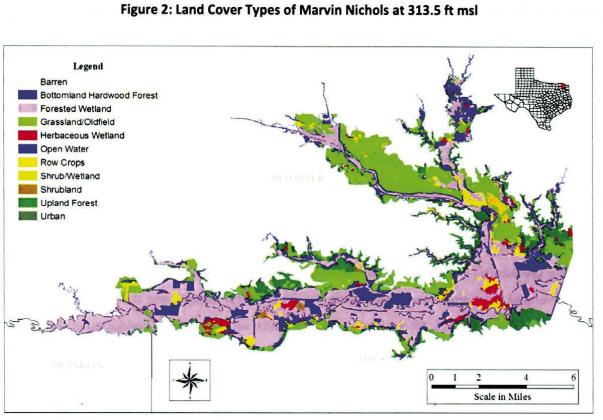
This proposed behemoth, 66,000 acres, would fill up the Sulphur River Basin from right about Hwy. 259 around Dalby Springs all the way back to Hwy. 37 in Red River County south of Clarksville.
If you are from here, and you look at the proposed drawing of the lake on a map, it is hard to miss the fact that there will be towns, communities, farms and generations of history put under water. Not very deep water in some parts, but nevertheless, under water.
Aside from the massive hole in the ground that would be filled with water for the lake, the construction of the lake would require vast amounts of land to be set aside to replace the wetlands and wildlife habitat that would be drowned under the surface. The mitigation that will be required if Marvin Nichols ever comes to be has the potential to gobble up the entire Sulphur River basin, virtually eliminating its use for anything other than a wildlife sanctuary, like the White Oak Creek Wildlife Management area.
The amount of land required to mitigate a given project is determined by a formula of habitat values. It is not just a matter of how many acres will be lost to the project, but also how high-quality the habitat on those acres is. There’s also a provision that the mitigation land be “like kind” – that is, of the same habitat type as the land that is impacted.
Bottomland hardwood forests must be chosen to compensate for bottomland hardwood forests lost, emergent wetlands to mitigate for emergent wetlands, etc. The mitigation lands are to be located as close as possible to the site of the project being mitigated.
When you boil it all down, those opposed to the lake’s construction agree that now is the time for everyone to speak loudly and clearly to the Texas Water Development Board and tell them that Marvin Nichols is not wanted here in Northeast Texas.
To aid in this effort, Preserve Northeast Texas has created a simple online form that will help you share your message directly with TWDB. You can find the link at: https://bit.ly/NoMarvinNichols The results of that study are scheduled to be presented to lawmakers and Governor Abbott by January 5, 2025.
The TWDB was present at a recent regional water planning meeting and gave a presentation. The representative indicated that because there was no budget allocated for the study, what they are able to do is limited. There will be no public meetings or further research.