
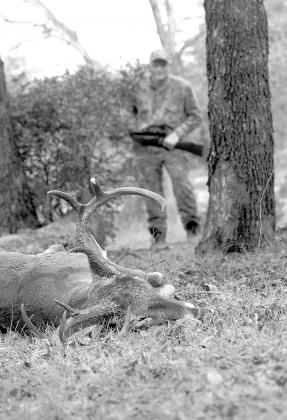
 Just about every successful deer recovery involves some degree of trailing. Hunters owe it to the game and the sport to make sure no stones are left unturned when it comes to search and recovery. (Photo by Matt Williams)
Veteran hunter offers useful tips for recovering deer that don’t fall in their tracks
Joey Waggonner, 59, knows a think or two about whitetailed deer. He has been deer hunting for most his life and says just about every successful deer recovery is going to demand some degree of tracking.
“The only time it doesn’t is if the animal drops right where it’s shot,” he said. “That doesn’t happen very often, especially with archery hunting.”
Waggonner has had a hand in recovering a passel of deer over the years. He says every animal and hunting situation is different. “Some tracks are easy, but others aren’t so easy,” he said.
He offered a few tips to help hunters be more successful at recovering deer that don’t drop in their tracks:
Be Patient: Waggonner says it is always best to stay put in the stand and wait at least 30-45 minutes before attempting to trail a deer that runs off after the shot. The idea is to give the animal sufficient time to hemorrhage and expire before approaching it.
“A white-tailed deer is a resilient animal,” he said. “A lot of times they he may go 100 yards or so and lay down. If you go in too soon you could cause him to get up and take off again. Adrenaline may push a deer another 400500 yards.”
Look for Blood: Always make note of where the animal was standing and the general direction it goes after the shot. Go to the spot where the deer was last seen and look for signs of the hit.
Waggoner says pink/frothy blood points to a lung shot — a good sign the deer probably won’t go far. Bright, red blood may be a muscle wound and could mean you are in for a wait. An arrow with nasty stench to it is a good indicator of a gut shot animal that can be next to impossible to find before the venison spoils.
Stay Quiet: Waggonner recommends being quiet as possible on the initial search. “If you find blood, go in quiet and don’t bring a bunch of people with you that could spook that animal. You shouldn’t take a group with you until after first day or so. At that point you’re looking for a dead body.”
When Blood Plays Out: Following a blood trail is the best way to track a wounded deer initially. Depending on the location and severity of the wound, some deer may bleed profusely and make the trail easy to follow. Other wounds may slow to a trickle or stop bleeding altogether.
“Follow the blood sign on the ground and watch for it on trees, bushes and limbs,” Waggonner said. “So long as you’ve got blood you can keep on going. If the blood plays out all of the sudden, it’s a good idea to back off for a couple of hours and wait. If you keep pushing, you may never find him. If you do, it could be by buzzards.”
This may also be the time to consider bringing in a tracking dog, “so long as it is a good dog with a proven history of success,” Waggonner said.
Making Loops: Recovering a deer with no blood trail can a tough proposition. Waggonner will start making strategic loops as a last resort.
“That’s how we found Wesley’s deer,” he said. “We made five big loops and walked about 6,000 yards, but we found him.”
Waggonner recommends making elongated loops at angles similar to fan blades. He begins and ends each loop at the last traces of blood. Each loop is about 50-60 yards wide and 400-500 yards long, sort of like a giant tear drop.
Know Your Neighbors: Waggonner said wounded deer and tracking dogs have no respect for property boundaries. Be sure to reach out to your neighbors first if you suspect a wounded animal may have crossed onto adjacent property, he said. ----- Matt Williams is a freelance writer based in Nacogdoches. He can be reached by email, mattwillwrite4u@yahoo. com.