
 Thousands of Texas hunters will take the field on September 1 as the 2023-24 dove season gets underway at 30 minutes before sunrise. Dove hunting is a feathered cash cow believed to generate about $316 million annually for the state’s economy. (Photo by
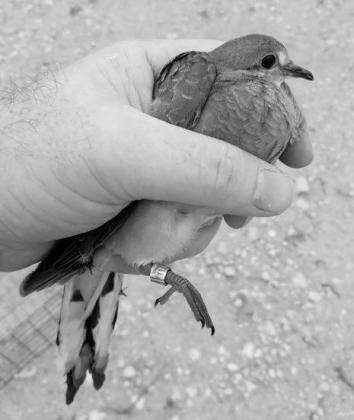 Hunters who harvest banded birds are encouraged to report the band identification number to the website listed on the band, www.reportband.gov. Scientists are able to gather all sorts of useful data from the banding program. (TPWD Photo, Billy Lambert)
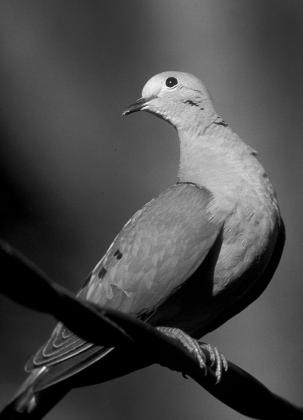 Mourning dove are the most abundant dove in Texas with a resident population estimated at 28.3 million birds. (TPWD Photo)
D-DAY
Every Texas dove season is a good one. Experts say the upcoming party that gets underway at 30 minutes before sunrise on September 1 in most of the state is setting up to be one of the best in years. If things don’t shake out, it certainly won’t be for the lack of birds.
That’s the word from Owen Fitzsimmons of San Marcos. Fitzsimmons is the webless migratory bird program leader with the Texas Parks and Wildlife Department. All migratory birds that don’t have webs between their toes are under Fitzsimmons’ watch. Doves are the webless kingpins.
Texas has more resident mourning doves and whitewinged doves than any other state. We also have more hunters — about 234,000 at last count, Fitzsimmons said.
Texas dove hunters shoot a lot doves, too. In 2022-23, hunters killrf more than 6.5 million doves, including 4.23 million mourning doves and nearly 1.7 million whitewings, according to TPWD’s small game harvest survey. Less numerous white tipped doves and exotic Eurasian collared doves rounded out the harvest.
Not surprisingly, dove hunting represents a feathered cash cow that accounts for a $316 million shot to the state’s economy each year. Hunters spend money on everything from shotguns and ammunition to gasoline, food, lodging, day fees and more.
Dove Status: Numbers Climbing Fitzsimmons recently released his 2023 Dove Status Report report. The report indicates a current resident mourning dove population estimated at about 28.3 million birds. White-winged dove abundance is about 11.7 million.
The good news is those numbers reflect significant increases at a time when dove numbers are declining nationwide. The U.S. Fish and Wildlife Service believes mourning dove numbers have been dropping at a rate of about one percent annually over the past several decades, Fitzsimmons said.
That’s because landscape isn’t near as dove-friendly as it once was. Fitzsimmons says scientists attribute the decline to changes in land use practices, including urban development, changes in agriculture, loss/conversion of grasslands, increased use of pesticides, etc…, all of which impact doves through habitat loss and degradation.
“Doves can successfully inhabit almost any area in temperate North America,” he said. “Like many other wildlife species today, they are being squeezed on all sides due to the rate and scale by which humans are affecting the landscape.”
The biologist is stoked by the fact Texas’ mourning dove abundance climbed about 44 percent in 2023 from a low of 19.8 million in 2022. That’s about three percent higher than the long term average of 27.5 million dating back to 2008, but well shy of the 37.5 million high mark recorded in 2016. It’s the biggest increase recorded since 2012, he said.
White-winged dove numbers are up about 20 percent over 2022 and 19 percent higher the long term average of 10 million birds. The 2023 total of 11.7 million birds ties the previous all-time high from 2015.
The increases are attributed to banner hatches in spring and summer of 2022, Fitzsimmons said. He’s anticipating another great hatch this year, which should spur another population spike in 2024.
Rural and City Dwellers TPWD’s dove report also summarizes some differences in geographic preference between mourning doves and whitewings some readers may not be aware of.
Annual population estimates are based largely on surveys that are carried out using a technique called “distance sampling.” The statewide surveys are always conducted during the height of the birds’ nesting season, which typically runs from about mid-May to mid-June. Biologists and technicians basically drive around on 20-mile routes in rural and urban areas, stop for three minutes at each one and document every bird they see or hear.
The report shows 89 percent of state’s mourning doves are rural dwellers, whereas 85 percent of whitewinged doves documented in the survey are urban birds. Whitewing densities in urban areas in 2023 were 213 times greater than in rural areas; mourning doves in urban areas were 2.1 times more plentiful in urban areas than in rural settings.
Watch For Jewelry
Annual banding efforts also play a key role in establishing population estimates, management strategies and dove season guidelines adopted at the state and federal levels. Fitzsimmons says every state with a dove season participates the USFWS banding program by trapping wild birds and equipping each one with an aluminum leg band.
TPWD biologists banded about 2,200 mourning doves and and 2,500 white-winged doves this summer. Each band has a unique identification number. Hunters who harvest banded birds are encouraged to report it to the website listed on the band, www.reportband.gov.
Scientists are able to gather all sorts of useful data from the banding program. Among other things, it tells them how far the birds are prone to travel and how old they are. The oldest known mourning dove — a male — was at least 30 years, 4 months old when it was shot in Florida in 1998. The dove was originally banded in Georgia in 1968.
Fitzsimmons says Texas hunters recover jewelry from migrant mourning doves every year. He’s heard reports of Texas-killed birds wearing bands as far away as North Dakota, Michigan, Pennsylvania and Oregon. He noted that the average age of a mourning dove is about 1 1/2 years, but numerous bands have been recovered from birds that were significantly older.
The oldest one I’ve seen is 12-13 years,” he said. “It’s not real common but we get some every year that are 8-10 years old.”
Season Outlook
With dove numbers up in every ecoregion and limited water in most areas due to the drought, Fitzsimmons is forecasting some banner shoots on the season opener. Dove season gets underway on a Friday this year, just ahead of the long Labor Day weekend.
“I have been been in contact with biologists in different areas they are corroborating the numbers with what they are seeing on the ground,” he said. “They are seeing more birds than they have seen in several years. If nothing changes between now and opening day there are going to be a bunch of birds on the landscape. I would definitely concentrate on available water. Even the small water holes will be productive this year.”
Stands of sunflower, croton (goat weed) and other seed bearing forbs and grasses also will be big draws. Early morning and late afternoon hunting will best. Fitzsimmons expects the birds will retreat to cooler shade at midday if the relentless heat sticks around.
As always, the X factor to watch leading up to the season opener is the weather. Doves are very sensitive to change. Extreme weather events like cold fronts can move birds around and cause them to scatter. The same is true of big rains.
“Right now water is going to be the limiting factor ,” Fitzsimmons said. “The biggest thing to worry about at this point is potential weather coming in and throwing a kink into things. It seems like you can almost set your watch by some sort of cold front coming in around September 1.”
Dove Season at a Glance North Zone: September 1- Nov. 12 and December 15-31 Daily Limit: 15 birds, No more than 2 white-tipped Central Zone: September 1 - Oct. 29 and December 15 - January 14, 2024 South Zone: September 14 - Oct. 29 and December 15 - January 21, 2024 Special South Zone White-winged Dove Days: September 1-3 and September 8-10.
Legal Shooting Hours: Noon to sunset
Low Cost, High Quality Hunting
Dove hunting is arguably the best low cost, high quality option available to Texas hunters. There are dozens outfitters around the state who offer affordable day hunts and package deals in good dove country. Internet websites like texasdovehunters.com and ultimatedovehunting. com are great resources for booking a private lands hunt.
TPWD’s public dove lease program offers hunters access to more than 100 areas under lease from private landowners for dove and small game hunting. Most are located near metropolitan areas and offer good dove habitat. A $48 Annual Public Hunting Permit is required. To review the leases, check out tpwd.texas.gov/huntwild/hunt/public. The dove leases are shown as clickable gold stars on the interactive map.
Getting Legal * Hunting License/Stamp and Hunter Education: Every hunter must have a current Texas hunting license and migratory bird stamp endorsement. Additionally, every hunter in Texas (including out-of-state hunters) born on or after Sept. 2, 1971, must successfully complete hunter education certification. Minimum age for certification is 9 years; the cost is $15. Uncertified hunters (unless exempt) must be accompanied by a person who is at least 17, who is licensed to hunt in Texas, who has passed hunter education or is exempt (born before Sept. 2, 1971), and you must be within normal voice control.
* 15 Birds Daily: Each hunter is allowed 15 total doves daily; you cannot kill a limit in morning and go hunting again in the afternoon. A limit may include all 15 mourning doves, 15 white-winged doves or a combination of two, but no more than two whitetipped doves.
* Eurasian Doves are a Bonus: Eurasian collared doves are exotics that don’t count towards your limit. Leave the feathers on all collared doves for identification purposes until reaching your final destination, just in case you get checked by a game warden.
* Don’t mix birds: Always keep your birds separate from other hunters in case you get checked by a game warden before reaching your final destination.
* Shotgun Plug: Pump and auto-loading shotguns must be plugged to accept no more than three shells, including one in the chamber.
* Watch for Bait: It is illegal to hunt migratory birds around an area that has been baited. Fines can be brisk. Leave the area immediately if you suspect foul play and contact a local game warden. Ignorance is no excuse if you get caught hunting over bait.
* Legal Shooting Hours: Legal shooting hours are 30 minutes before sunrise to sunset, except during the special white-winged dove season, noon to sunset.
----- Matt Williams is a freelance writer based in Nacogdoches. He can be reached by email, mattwillwrite4u@yahoo.com.