

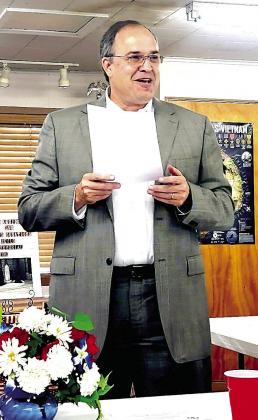
 CHRIS SPENCER
The future water needs of Northeast Texas discussed at recent meeting
Northeast Texas business owner and activist Chris Spencer spoke to a full house last week at a meeting of the East Texas Republican Women, held in Atlanta. Spencer is a Morris County native, graduating from Hughes Springs High. He was appointed as the Chairman of the Sulphur River Basin Authority in 2018 by Governor Abbott.
Spencer spoke in his role as the chairman of the Sulphur River Basin Authority and told the ladies gathered there of the role of the SRBA to manage the conservation of the State’s natural resources within the Sulphur River Basin.
Spencer went into detail about the water rights of Northeast Texans and noted that though the water in the basin belongs to the State of Texas, he and the SRBA act as fiduciary agents for those resources.
THE SRBA chairman also spoke about the Clean Rivers program. The Texas Clean Rivers Program (CRP) was implemented to maintain and improve the quality of surface water resources within each river basin in Texas. The CRP is a partnership involving the TCEQ, other state agencies, river authorities, local governments, industry, and citizens. Using a watershed management approach, CRP partner agencies work with the TCEQ to identify and evaluate surface water quality issues and to establish priorities for corrective action. The CRP provides a vehicle for local, regional, and statewide interests to examine water quality issues on a watershed basis. Planning and management by watershed allows the examination of complex relationships between water resources and human activity. The water quality assessments performed under the CRP focus on the cumulative effects of a variety of potential pollutant sources within the context of the natural setting of a particular watershed.
Spencer also spoke about the controversies surrounding the SRBA over the last 20 years, and his hope that those controversies have begun to subside in recent years. He noted that a lot of that controversy has been centered on the water rights of Northeast Texans, specifically with the efforts of those in the Dallas/Fort Worth area to develop the Marvin Nichols Reservoir. As part of that conversation, Spencer noted that it has been said, “Whiskey is for drinking, water is for fighting wars.”
The speaker made note that the proposed reservoir is close to 67,000 acres, roughly four times the size of Wright Patman and Lake Ray Hubbard.
Spencer told those gathered that although the size of the lake is monstrous, the “devil is in the details” as he explained that mitigation was the biggest impact of the proposed reservoir. Mitigation for Marvin Nichols could be as much as 200,000 acres.
Spencer declared that 200,000 acres taken out of the Northeast Texas landscape would decimate the timber industry here. Spencer said, “I believe timber is a crop, just like any other crop. 200,000 acres coming out of the timber industry is a big lick.”
The SRBA chairman also went into detail about the future of the proposed reservoir and the water needs of Northeast Texas, and Texas as a whole, drawing attention to the fact that the Sulphur River Basin is the most underdeveloped watershed in all of Texas.
He said that Texas water planners have determined that there was going to be less water available for future needs than had previously been thought. Spencer informed that a recent study had determined that there was significantly less water in the Sulphur Basin than there was before the past drought of record, that occurred in 2011. That, and other water shortages around North Texas, had changed the plans for the need for Marvin Nichols from 2070, to what is now listed as 2050.
“What is devastating about that,” according to Spencer, is that the latest reservoir developed was the Lower Bois D “Arc north of Bonham and that reservoir took 28 years from the permit phase to actually holding water. Spencer remarked that if water planners were to meet that 2050 date that they say is now the benchmark, they would realistically have to start the process of developing Marvin Nichols today.
Spencer stated, “As chairman of the SRBA, my fiduciary responsibility is to the state…but 20 percent of my livelihood comes from Ward Timber, so you can extrapolate what that might mean and where I would stand on it….All options should be on the table besides development.”
As he spoke to the crowd gathered there, Spencer made note of the need for conservation and reallocation to meet the future water needs of the state and the area.
Spencer noted that the reallocation of Wright Patman waters could be a viable option, stating that as it stands today, Wright Patman has “more than enough water” to meet the region’s needs for the next 30 years.
Spencer also spoke about the recent wave of solar development in Northeast Texas, especially in Red River, Lamar, and Franklin counties, and the fact that it has eaten up a lot of the acreage that might have been used for Marvin Nichols mitigation, which would eventually be an impact for mitigation of the proposed reservoir if and when it is developed.