
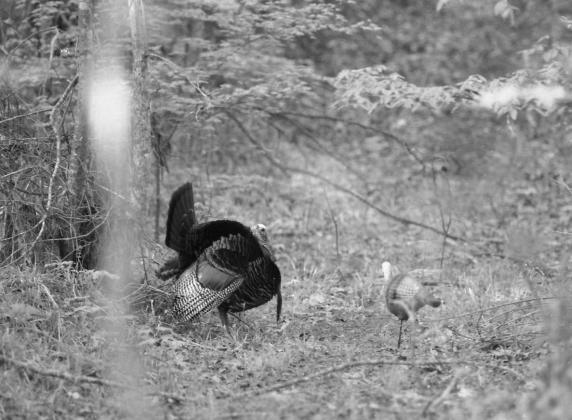
 A wild turkey gobbler checks out a decoy on a crisp April morning.Spring turkey season in full swing across Rio Grande country and hunters are experiencing mixed results. Eastern turkey season runs April 22 - May 14 in 12 East Texas counties. (Photo by Ma
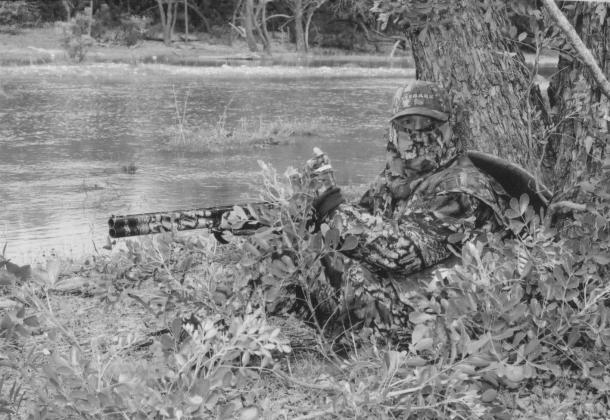 Spring turkey hunters should wear full camo as they attempt to call birds in close. (Photo by Matt Williams)
Tips for turkey
One of the cool things about calling spring turkeys is no two hunts are ever the same. The idea is to fool a gobbler into thinking you are something you are not, and to ultimately lure the regal bird into shotgun range, 40 yards or less.
Not every spring gobbler winds up being an April fool, but a bunch of them do.
The best hunts sometimes end soon after they begin. A hunter toots on a call and a boss gobbler comes rushing in like suicidal puppet on a string.
One shot. Lights out. End of story. Other times it doesn’t seem so easy. Some birds may gobble once and never make another peep. Others might answer an invitation repeatedly, all the while heading in the opposite direction with a group of lady friends.
Texas Parks and Wildlife Department wild turkey program leader Jason Hardin has heard reports from both sides of the fence this season. He’s also made a few hunts himself.
“I’ve had birds try to run me over and had birds come sneaking in silent from behind,” he said. “That’s pretty typical of spring turkey hunting. Every bird is different. Find the right gobbler without any girls and he’ll probably act right.”
Several public lands hunters found success earlier this season during two separate drawn hunts the James E. Daughtrey WMA in McMullen County. Hardin said 27 hunters participated in the first hunt and killed eight gobblers; 21 hunters shot eight gobblers in the second hunt.
Spring turkey hunting seasons are scheduled around the wild turkey’s breeding season. Mature gobblers are usually most responsive to calling once hens are bred and tending nests.
Here are a few recipes for success gleaned from savvy turkey hunters: * Full Camo - A turkey has a brain the size of a pea, but its eyesight is incredibly good. Don full camo head to toe and stay still as possible.
* Full Choke: Any 12, 16 or 20-gauge shotgun is sufficient for killing turkeys. It is best to equip the barrel with a full choke. The tight choke restricts the shot pattern, so more pellets are likely to find the kill zone.
* The Right Shot: Don’t attempt to body shoot or take a shot a flying turkey, even at close range. Aim at the base of the neck.
* Proper Load: Use quality shot shells with plenty of knock down power. High velocity turkey loads with No. 4-6 shot are ideal. If you have access to shotgun that will accept 3-inch shot shells, use it.
* Check it In: Successful hunters in 22 counties are required to report the bird to TPWD within 24 hours using My Texas Hunt Harvest app or the TPWD website: Bastrop, Caldwell, Colorado, Fayette, Jackson, Lavaca, Lee, Matagorda, Milam and Wharton, Bowie, Cass, Fannin, Grayson, Jasper, Lamar, Marion, Nacogdoches, Newton, Polk, Red River and Sabine.
* Taking Aim: Don’t attempt to shoulder a shotgun if you can see a turkey’s head. It’s best to wait until the bird’s vision is blocked by a bush or tree before raising the shotgun.
* Learn to Call: You don’t have to be crackerjack with a call to be successful, but it helps to know the basics. If you can yelp and purr, you can call a gobbler. The easiest calls to use are the slate and box; a diaphragm is the most difficult. Practice often.
* The Right Set Up: The girls go to the guys in real life. Always try to set up at locations that offer a gobbler the path of least resistance. Gobblers are prone to “hang up” on creeks, ditches and fence lines.
* Things that Bite: Protect yourself from mosquitoes and other vectors by wearing a good insect repellant. It also a good idea to invest in a pair of knee high snake boots.
------ Matt Williams is a freelance writer based in Nacogdoches. He can be reached by e-mail, mattwillwrite4u@yahoo.com.