
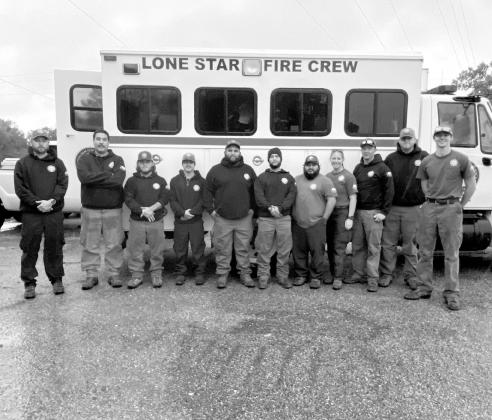
 Lone Star State Handcrew were headed out to fight Kentucky wildfires Friday and planned to stay through Thanksgiving, but were rerouted to McDonald Observatory at the last minute, due to the drought-riddled state finally receiving rain.
Lone Star State Handcrew sent to Kentucky,rerouted
An 11-member Lone Star State Handcrew, comprised of Texas A&M Forest Service volunteers was all set to head out Friday for a long drive to Kentucky in an effort to answer the state’s call for help with wildfire suppression efforts.
Unexpectedly, the crew got a call to demobilize at the last minute and are now headed to McDonald Observatory in Fort Davis, Texas where they will continue with an ongoing fuel reduction project, said Sean Dugan, Texas A&M Forest Service public communications officer.
The brave handcrew, which consists of volunteers that hailed from all over the state of Texas, had agreed to help man a fire suppression module. A handcrew uses hand tools like chainsaws to help with fire fuel reduction, and other management duties related to beating back at the flames.
The group was scheduled to be gone between 2-3 weeks, including spending their Thanksgiving Holiday answering Kentucky’s request to other states for support in suppressing the brutal wildfires they’d been fighting for weeks.
The Lone Star State crew buggy—specialized to hold nine passengers, along with personal items, hand tools, and other equipment needed for the perilous work they were about to undertake— had just been rigorously loaded down by the crew and other forestry workers nearby \\when they received a call to demobilize and head home. Kentucky’s wildfires were getting pelted by rain at long last.
The nine team members that were headed for the crew bus, as well as crew boss Michael Boucher, who was set to drive an additional pickup with one other crew member instead got rerouted to the McDonald Observatory.
“The state of Kentucky was experiencing increased wildfire activity due to persistent drought and weather conditions that are conducive to active wildfire behavior,” Dugan said. Dugan and outgoing handcrew members said Kentucky wildland firefighters had been tirelessly battling wildfires for more than a month and had requested assistance and support in the form of additional personnel and equipment to help with wildfire suppression.
“Kentucky ended up getting rain just as the crew left,” Dugan said. “So the crew redirected and are heading out to Fort Davis to continue with a fuels reduction project at the Mc-Donald Observatory.”
Boucher said they were originally headed to Moorehead, KY where wildfires had been raging.
Sometimes a handcrew constructs ‘firelines’, where they clear strips of land down to mineral soil to remove all flammable materials, along with burnouts and various other specialized jobs.
Handcrews are sometimes known to hike several miles per day fighting wildfires and Dugan said it was a good possibility that the crew might find themselves in a situation where they had to make camp.
Since nature has seemingly taken care of the Kentucky wildfire problem, Dugan said the crew was happy to redirect to the University of Texas at Austin’s McDonald Observatory. The observatory is known to house one of the world’s largest optical telescopes, the Hobby-Eberly Telescope (HET), which captures light from stars and distant galaxies to help astronomers study the cosmos, according to their Website mcdonaldobservatory. org. HET just reached a huge milestone last month, with 25 years of service to the observatory.
One might wonder just what the UT McDonald Observatory has to do with a Lone Star wildfire suppression handcrew.
“Essentially, we are in a partnership with the observatory and UT to help mitigate fire risk around the telescopes and the complex as a whole,” Dugan explained. “We can’t use prescribed fire because the ash interferes with the mirrors on the scopes. So, the handcrew heads out with chainsaws and reduces excess fuel (debris) by hand.”
“It’s been an ongoing project over the last couple of years,” he added.