
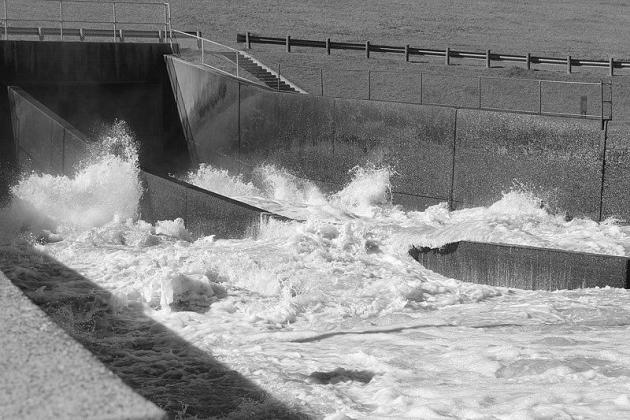
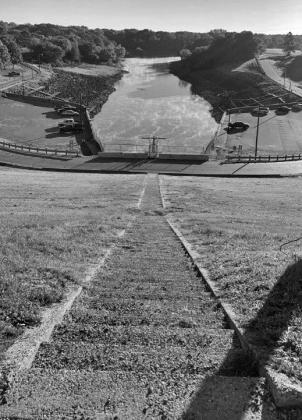
Wright Patman Spillway repairs come to a close
The Corps of Engineers expects to finish about $1.5 million in preventative repairs and upgrades to Lake Wright Patman spillway sometime this week, according to Lake manager Matt Seavy.
Seavy referred to the process as recapping and said engineers should be finishing this week but must give concrete about seven days to cure before placing water back into the basin.
The removal of the cofferdam and refilling of the basin is estimated to start by Oct 11, he said. For local fishermen, this means anglers can look forward to getting back to their favorite fishing spot very soon.
“The dewatering itself is a normal operation we do every ten years,” Seavy said. “It’s just a time for us to evaluate the condition of the outlet channel.”
However, this year, the corps wanted to take a look at the whole structure of the dam, originally built in 1950, to make sure it was well-maintained by doing some preventative work. “We were looking at concrete and the whole structure of the dam to make sure things are functioning at the highest level,” Seavy said.
The last time the corps of engineers did the dewatering–about 10 years ago–they noticed a couple of things that they thought would require attention within the next few years, so they decided to go all out this year and make repairs while dewatering the basin, just to stay on top of things.
“We noticed some erosion last time, so this time we decided to dedicate some of this time to doing these repairs to keep everything functioning at the highest level possible,” Seavy said. “This is just preventative work.”
There is no reason for anyone to believe that the spillway or the dam are structurally unsound, he added.
The Corps began work in mid-September by building a cofferdam, estimated at about nine-feet, to separate the main part of Sulphur River from the basin. A cofferdam is an enclosure built within a body of water to allow the enclosed area to be pumped out. This pumping creates a dry working environment so that the work can be carried out safely.
Seavy compared a cofferdam to a ramp of concrete similar to a swimming pool that breaks up the energy of the water coming through to keep the enclosure dry.
The Corps and contractors pumped water from the basin using two pumps, Seavy said, with the pumped water sent back downstream in order to keep the river aerated. While pumping the water out, Seavy said they checked the riprap on the shoreline that is meant to protect against erosion.
Riprap, also referred to as rip rap, rip-rap, rock armor, armoring, or revetment and is rock used to protect shorelines against natural water and weathering damage. Granite and Limestone are the most common rock types used in a rip-rap; Wright Patman Lake uses granite stones.
“We tried things different this year,” Seavy said. “We aerated the highway 59 boat ramp so we had a lot of the fish go downstream.”
Fish and wildlife were removed from the basin and sent downstream, including about 50 tons of fish–mainly gar and buffalo, but some catfish, too. University of Texas-Tyler students removed mussels from the basin while the Corps made sure old weights and lures for fishing were also removed, Seavy said.
“Quite a bit of debris was removed from that area,” Seavy said.
The Corps couldn’t forget about the Wright Patman pelican that stays at the lake year-round. Engineers have not yet named the pelican.
“Our pelican stays there all year, I suspect he can’t fly very well, so we just made sure we moved him safely downstream,” Seavy said. “He’s there year-round until his friends come back.”
After safely removing all the fish and wildlife and making sure the basin was clean and dry, the project began concrete resurfacing. Seavy said about nine inches had been poured by Texarkana Concrete Company about a week ago.
“We poured a slab of concrete in there the last time and they had to remove and re-pour it,” Seavy said. This concrete is very thick and takes about a week to cure—which is what workers are waiting for now.
The Corps said if they didn’t do maintenance work like this, issues with structure could compound and raise the risk of the dam flooding.
“This was definitely just normal wear and tear that we were working on, nothing critical,” Seavy said. “It wasn’t one of those things where we looked and said ‘Oh my gosh this needs immediate attention,” Seavy said.
“We just always try to stay way ahead of things, way before any problem could arise,” he added.
While anglers anxiously await access to their favorite fishing spot, Seavy said work should be done within the next few days or a week. Monday the area was still barricaded off for the public’s safety.
“This is a big area for people fishing,” Seavy said. “We are finishing off the work now but there was more construction this year so we were trying to keep everybody out of there for their own safety.”