


Teaching the young to appreciate the old
With an infectious passion for history and preservation, Gary Endsley has made a career of teaching the young to appreciate the old. Through his work at Collins Academy in Jefferson he has been instrumental in building and maintaining the Port of Jefferson nature habitat – as well as many other projects.
With his summer interns, college biology major Cameron Gentile and high school student Jackson Cain, he is currently working to identify and record the contents of a 50-year-old time capsule exhumed in Atlanta, Texas. The items were in a standard concrete coffin vault, but the seal had leaked over time and most of the contents were under water.
The time capsule project is a labor of love for Gary, an Atlanta native who has donated well over $2,000.00 in materials and labor, to his hometown cause. “This is a great opportunity for these guys to learn how to deal with these kinds of artifacts,” he said. As an Atlanta High School student, Gary was a member of the 1966 undefeated Rabbits football team his senior year. He received his bachelor’s degree of Biology/ Chemistry from the University of Texas, and his master’s degree of Adult Education from Texas A&M University. He taught school at both Atlanta and Queen City High Schools before joining the Collins Academy in 2007. He is also on the Cass County Historical Commission.
The capsule items that were in decent shape were recorded and bagged on site and left at the Atlanta Grade School for the public to see during Founder’s Day. The other items were taken back to the lab in Jefferson. As those items are dried, cleaned and identified they are placed in acid-free envelopes by reference numbers.
Where names are legible, Gary draws on his own knowledge, as well as asking other Atlanta residents to find the addressees. So far, many items have found their way into the hands of their intended recipients.
Mike Hanner, President of Hanner Funeral Services, was on hand to dig up the 50-year-old vault his grandfather, Hershel Hanner, buried in 1972. Several items were found on top of the pile of items - intact - addressed to he and family members from his grandmother Marie Hanner. Along with the letters, she enclosed five $100 Republic of Texas bills, two Atlanta Forest Festival Wooden Nickels and two $1.00 bills.
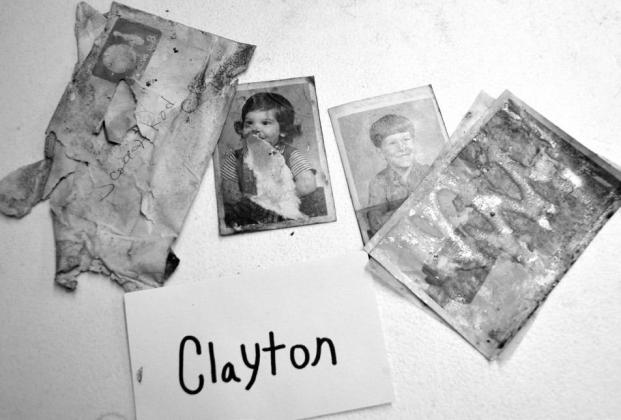
Rob Mason was presented a letter from his late mother, Jeri Blakey Mason, that included baby photos of he and his brother, Ron Mason. His hands shook as he opened the envelope and read the special note that expressed her love for them.
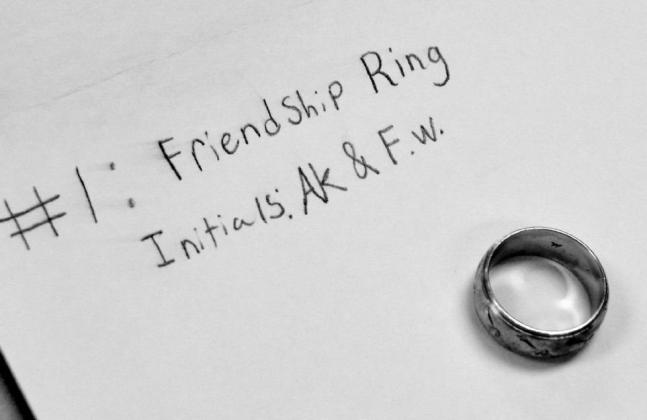
Other items in the collection ranged from mementos of the year 1972 – such as a Jimi Hendrix album – to personal letters and photos. Some of the random items were: a small Delta Airlines bottle of whiskey; American and Texas flags; 101 pennies dated 1972; a collection of 1972 magazines (including a Playboy); a bodysuit and mini skirt; the banner that hung over Hiram Street that spells out “Atlanta Centennial 1972”; a silver friendship ring engraved with initials; several copies of the Citizens Journal newspaper; two strands of pearls left for a young lady by her aunt (she has been reunited with them); and numerous loose photos and illegible letters.
The poor state of the items could be chalked up to the inadequate storage materials of the time. “They didn’t have plastic wrap or baggies or totes,” Gary said. “Tinfoil and string was the most common wrapping we saw.” Once the capsule was emptied, a new vault was readied to replace it. Items placed inside this time are most likely to fair better, given that all of them were placed in Ziploc bags, sealed with duct tape, then placed in plastic totes sealed with duct tape, then placed in Hefty lawn and leaf bags. Other projects Gary and his interns are responsible for include the Port Jefferson History and Nature Center, which involves beekeeping, gardening and native flora and fauna preservation. The Center is a hands-on, outdoor learning center and environmental park promoting habitat restoration along the historic riverfront in Jefferson, Texas. This is one of several sites where school groups have improved wildlife habitat under the guidance of Collins Academy and the U.S. Army Corps of Engineers. Educational programs, activities and outreach projects demonstrating the importance of history and nature are developed and managed by the Collins Academy team. A refrigerator in the Collins laboratory contains nothing but seeds of every native Jefferson plant, as well as some of the invasive ones. One of those invasive plants is the rapid multiplying, destructive Giant Salvinia water plant.
Through his work for the Caddo Lake Institute – an organization founded and chaired by Linden native Don Henley – Gary has helped to eradicate and control the growth of Giant Salvinia on the lake. Another Caddo project he is part of is the reintroduction of Paddlefish to the waterway.
The “American” Paddlefish (Polyodon spathula) is now the only surviving paddlefish species on the planet. The paddlefish has inhabited Caddo Lake, as well as other rivers and bayous of the Mississippi River Basin for over 350 million years, making them 50 million years older than the dinosaurs and the oldest living species on our continent. Paddlefish, which can grow to seven feet, weigh 200 pounds and live for 30 years, are now rarely found in any rivers in Texas.
Caddo Lake Institute and their partners have experimentally released paddlefish fit with radio transmitting tags on the Texas side of Caddo Lake and facilitated two separate releases on the Louisiana side of the lake, (not fitted with transmitters. The continued success of this project has led to CLI to assist with a second phase – the release of thousands of juvenile paddlefish into Caddo Lake to restore a viable population for the future.
In 2011, the Corps of Engineers and the Northeast Texas Municipal Water District agreed to revise, for 5 years, some of its operations at Lake O’ the Pines and provide the flow regimes for Big Cypress to the extent water is available. In exchange, CLI agreed to perform several sets of experiments to evaluate the benefits of the new release patterns. The Paddlefish work is one of those experiments.
Collins Academy staff is also building high quality virtual field trips that are available to anyone at any time. The Story of Jefferson, a backbone history of how steamboat navigation made Jefferson important to the settling of Northeastern Texas and all points to the West is available for viewing and expansion. It is aligned to the Social Studies TEKS for Grades 6-12.
For more information on these and other programs, the website is: collinsacademy.com.