

Redistricting leaves some frustrated
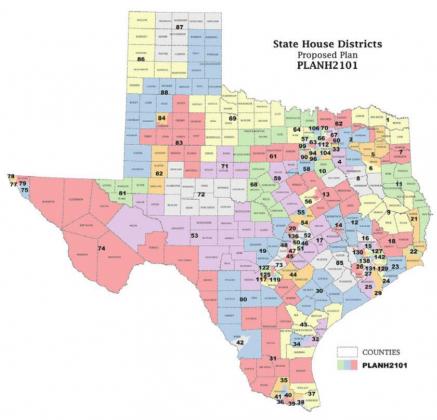
Typically, every 10 years the Texas Legislators redraw the district based on the census data and the political strategy by the party in power. This year the Republicans redrew the map leaving at least two groups of people frustrated. One group were the South Texas House Districts which represent among others Latino Democrats and on the other side the Texas rural communities which typically vote Republican. With the new redistricting, the Republicans hope to keep Texas in the hands of the Republicans in years to come.
For us in Cass County, it means that starting in the next election we will be in a new district voting for new candidates. Until then the “current candidates will remain our representatives till then. According to the Texas Tribune, “Gov. Greg Abbott on Monday approved Texas’ new political maps for the state’s congressional, legislative and State Board of Education districts, according to Texas Legislature Online. The new districts will be used for the first time in next year’s primary and general elections, barring any court interventions.”
After the census, the State of Texas picked up two new seats. With that in mind after the redistricting, the political makeup of the districts will change grammatically favoring the republicans. For instance, according to the Tribune, “In 2020, Trump won 22 districts and Biden won 14 districts. In 18 districts, the election was competitive, with neither candidate winning by 10 percentage points.” Now with the changes, “If the 2020 elections were held after redistricting, Trump would have won 25 districts and Biden would have won 13 districts. In 13 districts, the election would have been competitive, with neither candidate winning by 10 percentage points.”
For us in Cass County, there will be some major changes in the districts we will be voting in. For instance, for the U.S. Representative from Texas, we currently are represented by Pat Fallon in Texas’s 4th Congressional District, now if we had to vote today, assuming the current politicians continued to run, we would now be Texas’s 1st Congressional District, Louie Gohmert.
For the Texas House of Representatives, Chris Paddie represents Cass County in District 9, however the county now moves over to the 1st district which currently is represented by Gary VanDeaver. For the Texas Senate, the County will stay in District 1, but the map for each district above has changed dramatically. (See Maps). Currently Texas Senate, District 1 is represented by Bryan Hughes.
While Republicans are generally happy with the redistricting, because it should help them in general elections, it will most likely come at a cost to rural communities like here in Cass County. In the coming years, there is a general concern that issues that matter most to the rural areas will be put aside in favor of pandering to the larger areas within the district. For instance, concerns like the Marvin Nichols reservoir.
“We lost three rural seats in the Texas House through redistricting this year. Three rural state representatives in Northeast Texas, South-Central Texas and Southeast Texas decided not to run again, and their counties were absorbed into surrounding rural districts,” Texas Farm Bureau (TFB) Associate Legislative Director Billy Howe said. “We had one district redrawn to where it isn’t considered rural anymore, but a new rural district in Central Texas was created. So, we ended up only losing a net of three rural districts.”
Current Mayor of Atlanta Travis Ransom, who is currently running to be the County Judge, has some concerns as well. “I’m concerned about the shrinking rural voice. As the population in the urban areas outpaces the rural areas, we lose rural representation in Austin and in Washington. This makes it even more critical for Cass County to have a solid working relationship with the rural northeast Texas delegation of legislators.”
For Democrats around the state, there is a general concern that the new maps will come at the expense of minorities. “Texas politicians undermined representative democracy to remain in power for the next decade at the expense of Texas voters,” said state Rep. Rafael Anchía, D-Dallas and chairman of the caucus, reported from the Austin American Statesman.
For this reason, there have been several lawsuits challenging redistricting. “The Mexican American Legislative Caucus, which includes 41 members of the Texas House, all but one a Democrat, filed a federal lawsuit in Austin that seeks to overturn the new political districts as discriminatory. Also Tuesday, state Sen. Beverly Powell, D-Burleson, joined six Tarrant County voters in filing a separate federal lawsuit in Austin arguing that her district was dismantled to favor future GOP candidates in ‘one of the most extreme racial gerrymanders in the country,’” according to the Statesman.
Since the redistricting is still fresh, it is difficult to know how the lawsuits will hold out in court.
The website redistricting.capitol.texas.gov will continue to give more information about the redistricting process, they note so far that, “although the legal and procedural framework governing legislative redistricting under the Texas Constitution may remain the same, every decade sees a different, often unpredictable, path for state redistricting plans, depending on legislative, gubernatorial, Legislative Redistricting Board (LRB), and judicial action. The history of the redistricting process during the 1980s, 1990s, 2000s and 2010s illustrates some of the different courses decennial redistricting can take. In general, the procedural and legal requirements dictate that the basic process takes the course that is described below.
“While the order of the steps remains the same as indicated, the dates discussed are those required under federal and state laws. The COVID-19 pandemic led to a delay in the release of 2020 census data, and the data were not available before the end of the regular session. As a result, the LRB has no authority for redistricting in 2021, and legislative action relating to all district types will take place in a special session.
2021 changes include:
- apportionment data for congressional districts was released on April 26, 2021, rather than on the preceding January 1 as provided by federal law;
- detailed redistricting data was delivered to states on August 12, 2021, after sine die adjournment of the 87th Regular Session; and
- the 3rd Called Session of the 87th Legislature convened on September 20, 2021, to consider state legislative, congressional, and State Board of Education (SBOE) redistricting, among other issues.”