
 Cass County Poor Farm 1914



The forgotten paupers of Mockingbird Hill
Authors Note: In 1974 my mother, Jean Howe Stow, wrote an article for the January issue of Frontier Times magazine titled “Cass County Poor Farm.” In researching Mockingbird Hill Cemetery, I found her article cited as the main source of information on each website I visited. Her notes and published article, along with information found in the files of the Texas State Historical Association, were used as reference for this story.
It is customary, when one loses a loved one, to plan a memorial. Clothes are picked out for burial; a casket is chosen; family and friends gather; a funeral is planned; flowers are ordered; casseroles, cakes and pies are baked. The deceased is mourned.
While this all seems perfectly normal for most of us, there are those for whom no plans are made. As hard as it is to imagine, there really are those who have no one to gather and mourn them.
The state of Texas made provisions in the 1869 Constitution, Article XII, Section 26, which directed that each county shall establish a poor house, farm, and/ or homes for the needy or indigent. The sharp increase in indigency following the Civil War, accompanied by recognition that private charity, which had been relied on previously, could no longer cope, was apparently the motivation for its inclusion.
In Cass County one such farm was established on August 14, 1895 when the commissioners’ court authorized County Judge G.O. Albright to purchase the farm of a Mrs. Givins for the sum of $300.00. This land was located in the Pea Ridge area north of Linden Club Lake.
B.F. (Ben) Duncan of Linden was hired as the first superintendent and foreman of the county farm for the salary of $300 a year. He was also furnished with housing and provisions for he and his family.
Residents of the poor farm had been deemed as paupers by the county commissioners court and had no more than $10.00 of worldly goods to their name. Most were elderly persons with no family to care for them; others were physically disabled and could not work. In 1895 being deemed a pauper was so humiliating that most people felt the guilt and shame of the label for the rest of their lives.
Some of the residents were short term convicts who were arrested for such minor offenses as dice playing or fighting. They were sentenced to the farm to work out their sentences.
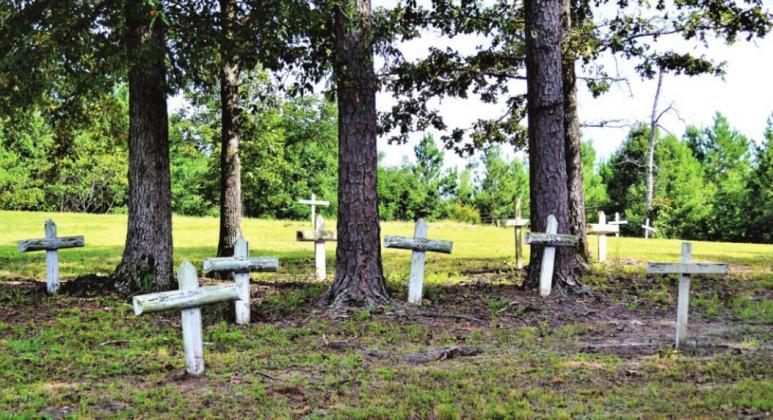
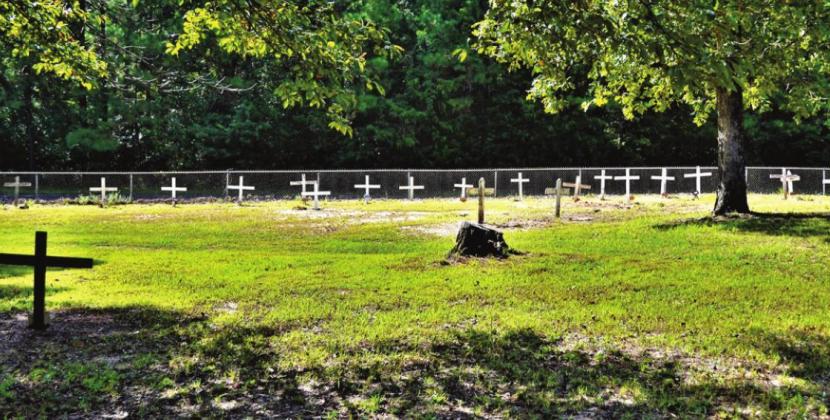
In 1900 the farm was moved two miles east of Linden on what is now County Road 1915. The structures are long gone, and all that remains is the pauper’s cemetery called Mockingbird Hill.
The county not only supported the residents while they lived there, they also buried them. One entry in the court’s financial records reveals the payment of $8.00 for a coffin for a pauper and a payment of $2.00 for the digging of a grave. All the coffins were alike, and a funeral service, complete with music and an officiating minister was supplied for each pauper who died at the farm.
In 1929 the Great Depression boosted the number of unemployed and needy persons to record highs, and local and state governments required the aid of the federal government in dealing with the problem of caring for all of them. In 1956 the doors to the Cass County Poor Farm were closed forever.
The county still owns the old cemetery, where plain whitewashed crosses mark the graves of the long-forgotten residents of the poor farm. Today, there is a section of more recent graves, bearing the same white crosses, where the county still buries those who have no one to pay for their interment.
The old people who died there, the ones who had no one to care for them and no funds to pay for a funeral, are buried on the hill, which was named in 1972 by county commissioner Hap Clements.
“I stood there among the graves of poor people and heard the song of a mockingbird there, sad and shrill,” he said, “it flew down and landed on a rock, then flew away, all alone.”