
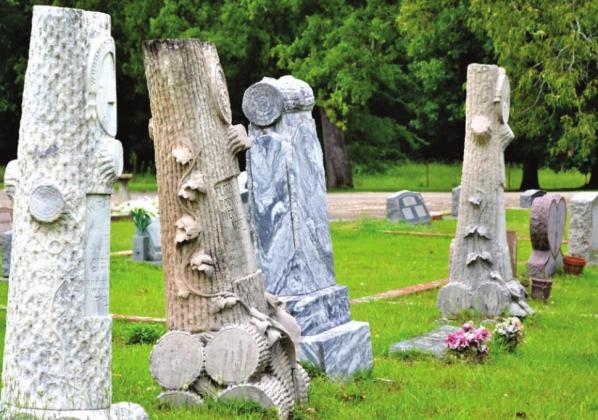
 A row of ornate Woodmen of the World monuments.
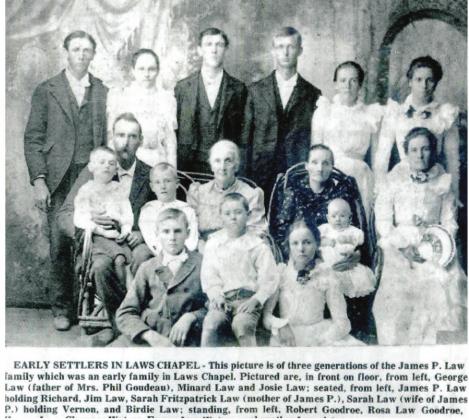
 George and Martha Law staked their claim just off the Old Linden Road on a hill close to a spring.
 Most of the older stones are close to the old Magnolia Tree in the center, where the roots of the tree have toppled the stones over.
 This cross was made from beams found under the church that was built in 1859.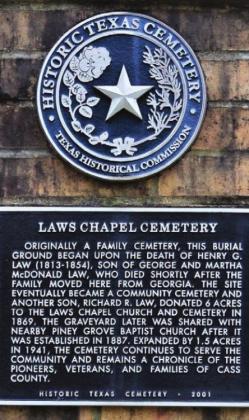


Laws Chapel Methodist Church and Cemetery
NOTE: Due to daily rain last week, our scheduled photo shoot for “This Old House” was cancelled. We stepped back, threw a Hail Mary, and had sunshine long enough on Saturday to get some fresh shots of the oldest church in Cass County. Dates and facts were collected from church members Ellen O’Rear, along with notes that my mother, Jean Stow, kept from articles she wrote for the Centennial issue of The Citizens Journal in 1972. We hope you enjoy this diversion.
It’s impossible for us to imagine being cooped up in a ship for 66 days in this era of modern travel, but in 1763 that’s exactly how long it took to sail from Scotland to America in good weather. While we cannot be sure of the exact route they took, we know that William and Jane Law, Presbyterians who relocated to Scotland from Ireland for reasons of religious freedom, left there and ended up in Charleston, South Carolina in 1763.
In March of 1853, their grandson, George Law Jr., wife Martha McDonald, led a wagon train of friends and relatives across the South into Texas. The journey was made over the “Texas Road,” which closely follows the current route of U.S. 80, through Alabama, Mississippi, Louisiana and, finally, Texas. The wagon train ferried three rivers, the Chattahooche at Bartlett’s Ferry, the Mississippi at Vicksburg and the Red River in Shreveport. The settlers then came north on the Clarksville Road to Jefferson and on into Cass County, arriving in late April 1853. The trip took 50-55 days.
They stopped in Linden, which had not yet been incorporated but was serving as county seat. Supplies were purchased from the store of John Moore, across from the new courthouse which was completed that same year.
They settled in the wild country of Cass County, along the Old Linden Road, close to a clear running spring. Until just a few years ago, the spring still flowed, filling a small lake just through the woods behind the church. That road is still partially existent today, beginning on FM 2328 (Law’s Chapel Road) heading South, parallel to Highway 59.
Law’s Chapel Church saw its beginnings a few weeks later when George and Martha Law invited friends and family into their home for a prayer meeting. Later that summer George, assisted by his slaves, built a brush arbor across from his house under a grove of oak trees.
Until a log church was built a few years later, worship was held under the arbor in summer and in members’ homes during winter months. The Texas Historical Commission recognizes this as the oldest Protestant church in Northeast Texas. Services were usually held about once a month by whatever circuit rider came along, regardless of his faith. At that time the church was interdenominational, as were the settlers, although the Law’s were generally thought to be Methodists.
A year after arriving in Texas, George and Martha’s son Henry died at the age of 40. He was the first person to be buried at Law’s Chapel, in 1854.
By 1859 a log structure was being utilized as Law’s Chapel Church and joined the Jefferson District of the Trinity Conference of the Methodist Church on Oct. 1, 1859. Conference documents indicate that a meeting was held at that time during which a missionary society was formed requiring one cent per month from male members. The document was signed by J.M. Stevenson, the preacher in charge and grandfather of later Texas Governor Coke Stevenson. Also signing was James Wiley Franklin Cook, appointed church secretary. Charles Hammill was named the first pastor.
During the Civil War, Laws Chapel residents contributed their share to the war effort, with all farm products assessed and the surplus sent to the army. In January 1862 a special war tax of ’ 25 cents per $100 property valuation was levied.
George Law died in 1864 before the end of the war; Martha died in 1865. Both are buried under the branches of a huge Magnolia tree in the center of the cemetery.
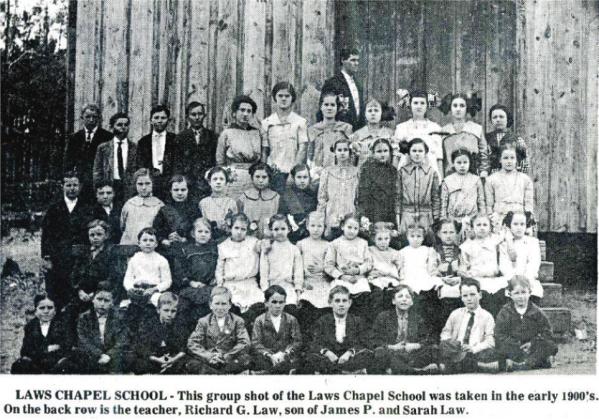
School was conducted at Laws Chapel as early as 1857 when children were taught by B.S. DuBose. Some of the textbooks used were loaned to Mrs. Henry Law in 1856 by her brother Marion Hill Fitzpatrick who taught school in Linden.
A school known to some as the Lumpkin School and to others as the Laws Chapel School was built in the early 1880’s one mile east of Laws Chapel. It was moved in 1908 to a location at the intersection of the Laws Chapel and Linden Roads. It was consolidated with the Piney Grove school in 1918 and known as Liberty Grove.
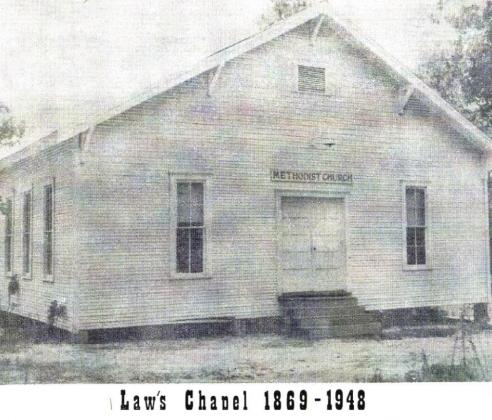
During the next few years a 30x40 plank structure was built to replace the log church building and a lean-to was attached for slaves to attend church. In 1869, Richard R Law, son of George and Martha, deeded six acres for the church and cemetery to the church’s trustees and their successor.
In 1925 ten feet was added to the building, which remained the same until it was overlaid with brick in 1974. Other improvements to the church were electrification in 1940, and later the addition of a vestibule and a kitchen and dining room.
Remodeling in 1948 added wainscoting, paneling and a composition ceiling. The handmade benches were replaced with pews from the First Methodist Church of Vivian, Louisiana, when that church was rebuilt in 1948. Central heat and air conditioning were installed in 1967; a steeple and chimes were added in 1998. The most recent renova
The most recent renovations included a new Fellowship Hall in August 2008. In 2014, the church sanctuary totally refurbished. New Sunday School rooms and a choir room were also added and will serve the current membership of 84 while having room for future growth.
A back porch, covered car port and a garden planted as a memorial to longtime members the late Col. and Mrs. Morris Dugger freshen up the outside of the church.
During its long history, the church has never been without a pastor. Some sixty ministers have served the church in this capacity, the current one being Dr. John Wilkey.
Law’s Chapel Methodist Church was recorded as a Texas Historic Landmark and received a Texas Historical Medallion on December 8, 1968. This event was marked with a Homecoming of former members of the church. Law’s Chapel again hosted a Homecoming in October 2003, marking 150 years of service to the community.
The cemetery was designated a Texas Historic Cemetery in 2001. It contains graves of Civil War veterans who served from Alabama before coming to Cass County as well as those who served from Cass County. It is also the resting place for veterans of World Wars I and II, as well as Korea and Vietnam veterans from both Laws Chapel and Piney Grove communities.
A slow walk through the rows of markers and tombstones reveals the history of the area. The many tall pillars shaped like tree trunks with amazing detail belong to members of the Woodmen of the World and are a testament to our timber industry. The countless number of veteran plaques dating back to the Civil War speaks to our unwavering patriotism.
As a child growing up across the street from this sacred place, I learned how to spot the century-old markers of infants who died in the days when finding a close doctor when you needed them was impossible. Finding the markers with all the same last names, one can use the dates to put the pieces of their family puzzle together. The huge magnolia tree that marks the center of the original family cemetery has thick branches you can relax on and write poetry or daydream.
The spring that drew and kept George Law on the hill was flowing freely just 20 years ago and people who lived in the community were often seen walking down the wooded trail with empty milk jugs to fill. It was absolutely the best water.
At some point in the not-so-distant past, new neighbors bought the land next door and chopped down the trees. The clear, sparkling spring was dug up to feed a small lake, a new fence was built.
Despite all the changes the church has gone through, it’s still far enough away from the highway to muffle the sounds of traffic. A slow stroll around the road behind the cemetery is still so spiritual it seems you just can’t get any closer to Heaven than that sacred ground you are standing on.