
 Anyone under 4 feet tall can climb into this amazing model of the “Jenny” plane flown by the legendary Bessie Coleman. Coleman was born in Atlanta, Texas to a family of sharecroppers and defied all odds when she became the first female African-America
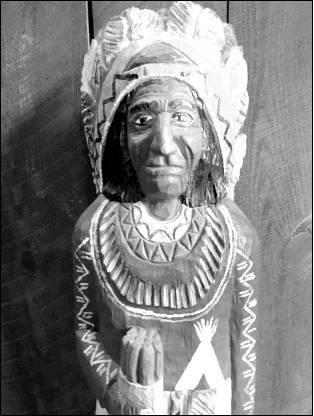
 A Caddo Native American Chief greets museum-goers as they take a step back in time. Caddo Natives called Cass County home and were an advanced agricultural tribe that impressed the Spanish with their beehive-shaped huts and furniture, built from the lumbe
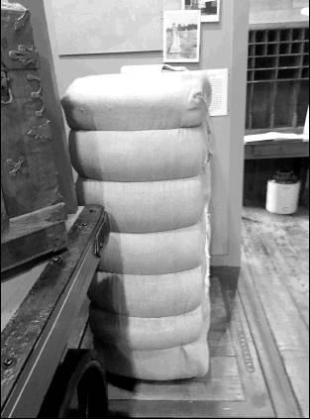
 A cotton bale rests upright in the museum near the railroad exhibit. Cotton and lumber were the two most prominent industries when Atlanta, Texas was founded.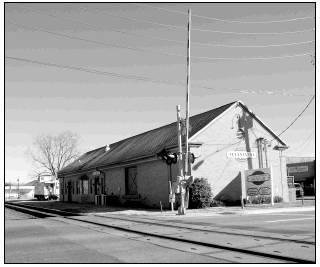
Museum provides a great history lesson
The interpretive museum is a great way for both children and adults to learn about the rich history of east Texas and the city of Atlanta, with exhibits that make learning about the area both interesting and fun.
Located near the railroad tracks at 101 N. East Street, the Atlanta Historical Museum is generally open from 1-4 p.m. Monday through Friday.
Upon stepping back in time, visitors will pass a nearlife-sized figure of a Caddo Indian Chief—no doubt in homage to the natives that occupied the Atlanta and Queen City area, specifically near the Red River. Caddo Indians hunted what we hunt here now; squirrel, deer, rabbits and fish, and were farmers. They gathered nuts and berries and farmed beans, corn and squash.
Local Caddo are known for etching beautiful designs into their pottery, which was important for cooking and farming. Caddo were considered to be an agricultural people, with a very developed culture. The huts they made from grass were beehive shaped and included furniture, unlike many other tribal homes.
The museum depicts the Texas and Pacific Railway between 1890 and 1910, the development of commerce for the 100-year period between 1850 and 1950, information about cotton processes and gins as well as all sorts of railroad/depot equipment.
Many other artifacts are placed behind glass panes, such as Caddo Indian tools, an officer’s World War II uniform, and a tribute to Bessie Coleman—the first African American female pilot—who was born in Atlanta, Texas.
A town just wasn’t a town without a post office back then. Atlanta officially became a town in 1871 with the opening of the post office and building of the Texas and Pacific Railway. The town received its name from settlers who came from Atlanta, Georgia.
In 1885, there was about 1,500 residents and lumber was the head industry. With the thick, piney woods nearby, it’s no wonder. Many of the people who had built their own homes here, also built their own furniture and before long, began producing more furniture, extra crops, etc., thereby calling for a “home office” for the family.
An example of a home office is shown in the museum, complete with a ledger, store papers, old letters, envelopes and pencils. Nearby, an old butter churner reminds you that lumber and crops weren’t the only surplus wares that families could sell, including butter.
Other top industries were sawmills and cotton gins. Sawmills were necessary to produce lumber from logs and trees. A handsaw hangs on the wall as a reminder of the old ways of sawmills.
Atlanta’s museum depicts a bale of cotton, as well as an example of the cotton gin. Short for cotton “engine”, the gin was invented by Eli Whitney in 1793. This machine helped shorten the process of removing the seeds from the cotton plant so that the cotton can be spun into thread or woven into cloth.
With the help of a cotton gin, one man could remove seeds from 50 pounds of cotton each day---ten times more than before. Cotton was a huge industry in the area around 1900.
A train depot, complete with a ticket window, a bench for waiting and a spit tune for tobacco chewing, is set up in the museum with information on the Texas and Pacific Railway. The railroad was key and essential in the founding of Atlanta.
A miniature model railroad nearby represents how the Texas and Pacific Railway Company trains, rails and countryside would have appeared between 1890 and 1910, complete with yellow refrigerator cars. A nearby farm has a cotton field and loggers are also shown using the methods that were used during this time. Atlanta looked very different, with most homes built within a block of the Texas and Pacific Depot and surrounding businesses.
An old switchboard reminds museum-goers that the simplicity of cell phones was not always the standard for making a phone call. Many wires and operators were used in the past to connect one caller to another and directories were commonplace. A 1957 telephone directory for Atlanta is on display on the switchboard.
According to the museum, thousands of Atlanta citizens have served in the United States military. Atlanta men and women represent America’s uniformed services around the world today. A uniform on display at the museum was worn by Atlanta native Brigadier General Kelley Arnold, who became the Deputy Commander of the 49th Armored Division of the Texas National Guard. Arnold served during the Korean War, Cuban Missile Crisis and Vietnam War, as well. His career spanned 44 years of national unrest.
Cass County made headlines by raising $1,366,200 to help fund World War I from 1917-1918. This was done by
selling Liberty Bonds locally. In July of 1920, the “Atlanta of Texas” steamship was launched, constructed by the Mobile Alabama Shipbuilding Company in honor of the county’s largest town. The ship was an all steel vessel weighing in at 5,000 tons. It was launched on the Mobile River.
Atlanta’s museum is especially proud to house a miniature scale model of “Jenny”--a Curtiss JN-4 plane-- similar to the one Bessie Coleman flew. Kids four-feet tall or shorter can actually get inside the plane and get a feel for what flying with Coleman would have been like in the open-cockpit biplane.
Coleman was the first female pilot of African-American and Native American descent to hold a piloting license in the entire country, as well as the first African-American that held an international pilot license.
Born in Atlanta in 1892 to a sharecropper family, Coleman became interested in flying from a young age but back then, women and African-Americans had no opportunities to flight train. Therefore, Coleman saved up her money and got sponsored to travel to France to follow her dream of flying and became famous early in her career while performing dangerous stunts in US air shows.
Panes of glass separate museum goers from photos of a glowing, grinning Coleman, along with a uniform similar to the Military-style jacket that Coleman had designed for herself for flying.
Bessie died young at age 34, while test flying a new plane. She was unable to realize her dream of starting a flight training school for African-Americans because of her sudden death. Still, Coleman paved the way for both women and African-Americans to dream big and not take no for an answer--therefore shattering glass ceilings and the lowered expectations of others.
Many notable people come from the Atlanta, Texas area. In addition to Coleman, Ellen DeGeneres and several professional sportsmen hail from Atlanta. It is safe to say Atlanta was a community born of leaders and continues in this tradition today.