
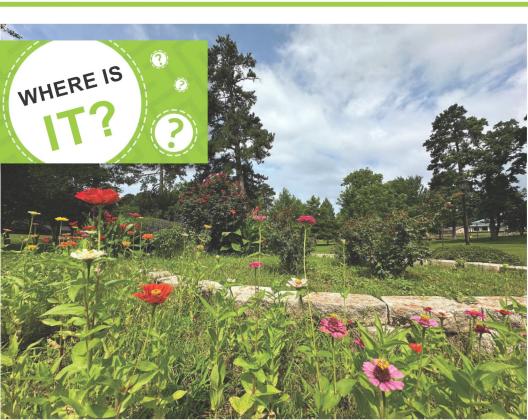
 Flowers, beds, paths and scenic views such as above abound on the lawn of the Atlanta District Headquarters of the Texas Department of Transportation. The restful retreat is a blessing to Atlantans. It is like having a highly-cared-for park in the middle
 Atlanta has an official walking path designated and explained by trail maps as starting points on the lawn of the Atlanta District Headquarters of the Texas Department of Transportation. 'Live Well, Work Well' the map says.
Where Is It?
With tall trees, pleasant stream, lots of green grass, picnic tables, strolling paths, stillness and silence, flowers and refreshment, Atlanta has a genuine park right in its midst. It is the Atlanta District Headquarters of the Texas Highway Department. A boon to the town since its establishment in 1932, do you know “Where This Is?” That is this week’s mystery game. Do you know how this park came about? Here’s a brief early history.
The states first highway department, the Texas Highway Commission, came in 1917, after the federal government said in 1916 it would give federal funds to states for road construction but only to those with a state highway department.
Texas had no highway department, but did have “some of the worst roads in the nation,” said a former highway director. “Getting the farmer out of the mud was a cliche at that time.”
So, by the next year, Texas had a highway department. At its first meeting, April 4, 1917, the three commissioners appointed George A. Duren state highway engineer and then adjourned. With no highways, they had no other business.
But the department had a purpose, i, e, to move travelers across the state.
Everyone had a stake in this department. Up until then, road building was the business of local communities. Every male was obligated to spend a few days a year working on the roads or to hire a substitute.
The “road overseer” of the commissioner’s court saw to these matters. Sometimes the “work crews” came out simply to have a good time of picnics and races. But road gangs of prisoners from county jails working on roads were a familiar sight in the South into the 1950’s.
When the state took over the task, funding was based on the concept that users should pay for highways. Automobile fees were charged, half of which went to the counties, and a gasoline tax was created, one-fourth of which went to the School Fund.
The state was divided into six districts which later grew to 25 by 1932. Work in the Cass County area was originally channeled through the Mt. Pleasant office and later the Paris and Tyler headquarters.
In 1930, it was rumored that the highway commission planned to create several new districts, and citizens of Atlanta offered a 20-acre tract of land on what was then Highway 77 and is now Farm to Marker 249 east of Atlanta. This was called the Gorman Estate. The tract was a beautiful park with three buildings.
District 9, consisting of the nine counties of Bowie, Camp, Cass, Harrison, Marion, Morris, Panola, Titus and Upshur, was created in March of 1932. W. D. Dockery was the first district engineer. S. C. McCarty came next followed by Ed Bluestein who served during World War II when highway work came almost to a halt.
For the next 20 years, Gilbert Youngs then presided over the most extensive road construction yet occurring, especially when the Federal Aid Act passed in 1956 and provided for construction of Interstate Highways, some 110 miles of which is located in District 9.
Lawrence L. Jester Jr. was appointed district engineer in 1972 and would remain for the next 21 years.