
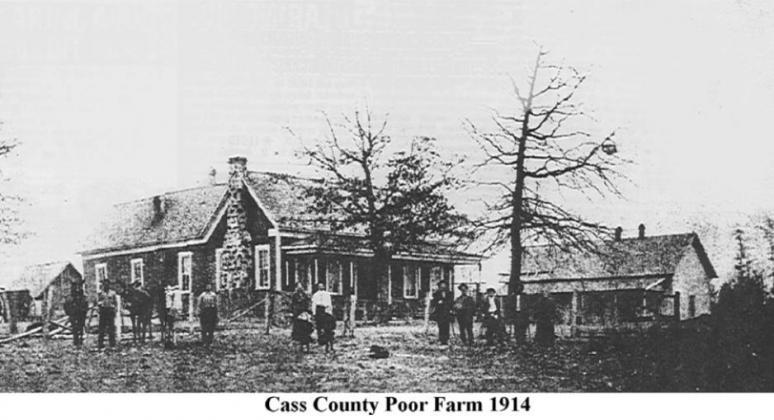
 Poor farm memories
 Poor farm memories
Poor farm memories
Atlanta, Texas
June 24, 1984
On Aug 14, 1895, the commissioners’ court of Cass County authorized County Judge G O Albright to purchase the farm of a Mrs. Givins for the sum of $300.00 to be used as the county’s poor farm.
This original poor farm was located in the vicinity known as Pea Ridge, about 2 1/2 miles north of the present site of Linden Club Lake.
To be eligible for residence at the poor farm, a person couldn’t own more than $10.00 of worldly goods to his name, and this was probably not the case with the pauper’s list, as many listed on it owned homes. Therefore, by establishing the county farm, the commissioners were able to considerably whittle down the relief rolls.
The county farm also was established for the purpose of keeping short term convicts. Mrs. Mable Buckland of Linden, whose father was superintendent of the farm for 15 years, said these convicts were mostly those arrested for such offenses as dice playing or fighting, and were sent to the farm to work out their sentences, usually staying less than a month.
On Nov 14, 1895, the commissioners’ court employed B F (Ben) Duncan of Linden as superintendent and foreman of the county farm.
The agreement under which he was hired read as follows: “B F Duncan shall be employed and paid $300.00 for his services as superintendent and foreman on the county farm, for a term of one year. The money will be paid to him monthly at $25.00 per month, and he will be furnished necessary stock, working utensils and other provisions for himself and his family without cost to him.”
Who were these “paupers” who came to live at the county farm?
For the most part, they were elderly persons with no family able to care for them and with no income of their own. There were also a great many physically disabled persons for whom working for a living was impossible. In addition, during the farm’s early years there were a few mothers with small children and no means of support.
According to Mrs. Buckland, in order to be allowed to move to the county farm, a person had to appear before the commissioners’ court and take a “pauper’s oath”. This required declaring to the county judge and commissioners, “I am a pauper”. Mrs. Buckland also recalled many were so humiliated after this experience that they never recovered but felt guilt and shame the rest of their lives.
Around the year 1900 the Cass County poor farm was moved to another location, approximately two miles east of Linden on the road now known as the old county farm road. Duncan still was the superintendent even though he had originally been hired for only a one year term.
Each November the court had rehired him for another year, and he remained superintendent until Nov. 15, 1905, at which time J. C. Erwin was employed by the court of County Judge W F Ford to fill the position.
Since the beginning of the Cass County poor farm, the commissioners’ court had visited and inspected the farm regularly On one such visit, commissioners report finding 33 of the farm’s acres planted in cotton and another 45 in corn They also noted the paupers seemed well cared for, and their rooms were “neat as a pin”
In addition to furnishing all the necessities of life for the paupers, the commissioners supplied them with the necessities of death. One entry in court’s financial records reveals the payment of $8 00 for a coffin for a pauper and a payment of $2 00 for the digging of a grave. Mrs. Buckland recalls all the coffins were alike, and a funeral service, complete with music and an officiating minister was supplied for each pauper who died at the farm.
In November 1914, Nat Jones of Linden became superintendent of the county farm. Nat Jones died in December 1918, and his brother, Edd Jones, became the farm’s superintendent, remaining in that position for 15 years until death claimed him too.
Edd Jones was Mrs. Buckland’s father, and it was she who offered as insight into the daily life on the farm, as she was 13 years old when her family moved there.
Mrs. Buckland stated that when the weather became exceptionally hot, her father was always afraid the convicts would suffocate in the farm›s jail. Therefore, he would leave the doors open to allow them to get fresh air, but he also gathered up all the convicts› clothes and took them with him. His theory was no convict would escape in only his underwear, and none ever did.
In August 1933, Edd Jones died. He was replaced as superintendent of the county poor farm by Elmer Almond, but even at that date the end of the farm’s usefulness as an almshouse was in sight. The Great Depression, which had begun in 1929, had boosted the number of unemployed and needy persons to record highs, and it had become evident local and state governments had to have the aid of the federal government in dealing with the problem of caring for these people.
When Superintendent Ed White, who had replaced Almond, died in 1956, he became the farm›s last superintendent and its doors were closed. The last inmate, an elderly woman, went to live with her sister, and all became quiet at the farm.
Although the county still owns the property, all that remains today of this unpleasant aspect of our heritage, serving as the Cass County Peace Officers› Club, and the old pauper cemetery, in which County Commissioner J H Clements had a fence and wooden markers erected and only a few months ago.
The whitewashed split-rail crosses bear no trace of who may lay beneath the markers, overgrown with brush. A lone bird song rang clear through the quiet hazy heat that lay over Mockingbird Hill Cemetery.
The unmarked graves are the last trace of a county poor farm where the destitute and disabled came as a last resort in the early part of this century.
The old people who died there, the ones who had no one to care for them, were buried on the hill and forgotten. No markers, not even nameless ones, marked their graves until 12 years ago when Hap Clements, then county commissioner of Precinct 4, urged the commissioners’ court to fence in the cemetery and mark the graves.
Mockingbird Hill was the name Clements gave to it.
“I stood there among the graves of poor people and heard the song of a mockingbird there, sad and shrill,” he said, “It flew down and landed on a rock, then flew away, all alone.”