
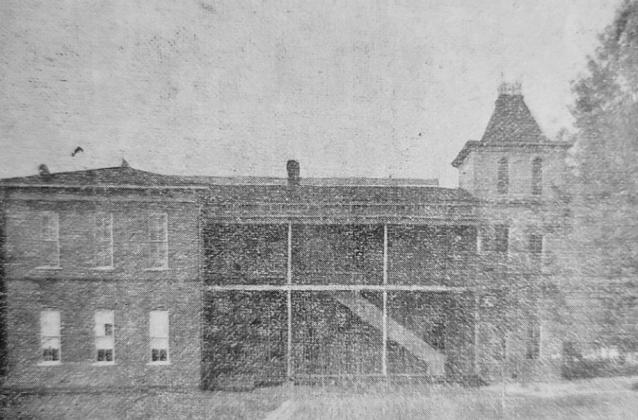
 The new two-story brick school immediately upon completion in 1893.
 The Viola School in McLeod, circa 1900.
 Springdale Community Teacherage (dorm for teachers) 1929
 Black Diamond School - Year and location unknown Front row, left to right: Leroy Jernigan, CLarence Vaughn, Jim Yates, Dena Vaughn, Yankee Scott, Velma Moore, Syble Thornton, Inez Thornton, Alton Yates, Dick McKelvey, Hilton BOyter, Raymond Endsley, Early
From one room to two stories - the early history of Atlanta schools
Early School Administration
The earliest records of school administration was in 1849, when it was shown that the County School Commissioners had acted on locating the four leagues of state school land.
The earliest schools did not have trustees. Prominent citizens of the school community assumed the responsibility; however, judges were appointed by the court to hold elections for school trustees and trustees were elected for the five districts in 1873. Appearing on the list of the first county trustees in District 1 was the name of Daniel Boon, grandfather of our County Superintendent, D.H. Boon.
By an act of the Legislature on May 22, 1873, the County Judge acted as County Superintendent.
Community Schools
The earlier schools were formed in a rather odd way. A few good citizens would feel the need for a school and would contact the parents who had children that might attend. A subscription rate of $1.50 per-month enabled a child to attend school. A teacher was then obtained and log cabin was erected or an old building was rented for the purpose. Then again, an energetic and unemployed teacher would go into a community and get subscriptions and establish a school himself.
These earlier schools were not in certain districts. There were five beats in the county and as many schools were established in any one beat as the need for same was felt.
First School Bond
The City Council in session, August 17, 1889, passed an ordinance issuing $6,000.00 in bonds, to buy ground, build and improve a building for a female academy in the city of Atlanta. Twelve $500.00 bonds, bearing 6% interest, payable at Third National Bank, St. Louis, Missouri, with interest on September 1, 1890, and each succeeding year until paid. This ordinance was signed by G. O. Albright, Mayor; and G.W. Robinson, Secretary.
The contract for the new building was let to W.A. Stuckey for $4,750.00 on August 28, 1889. This building was erected on the present school site.
The male school was named the Atlanta Institute and the female school was known as the Female Seminary. It was in a large frame building located just east of the Presbyterian church on Hiram Street.
School Always Came First
The City Council in session, June 3, 1889, was presented a petition signed by a number of Atlanta women, asking the Council to build a 40x60, two-story building for the establishing of a female school in the City.
A.Miles, R.M. Harp, and R.E. Boyles were appointed as a committee to solicit funds and see what could be done in the matter.
School Salaries Paid Early Teachers
The City Council in session on August 8, 1889. Professor Madden was offered $1,400.00 to teach the male department of the Atlanta grade school for eight months, with the agreement that he furnish two good assistant teachers.
Professor Horsley was employed to teach the female school at a salary of $125.00 per month for eight months.
Early School Superintendents
The County Judge and Commissioners Court attended to school matters until the appointment of a County Superintendent. The County Judge approved the vouchers issued by the school districts and the County Treasurer paid in cash the amount of the vouchers. Monthly reports were required as they are today.
Vol III, page 259 of the Minutes of the Commissioners Court shows that the Commissioners Court met on Monday August 12, 1907, and appointed Mr. M.G. Bates as the first County Superintendent of Public Instruction in Cass County. This Court was composed of: V.D. Glass, County Judge; J.P. Fant, H.C. Abernathy, H.O. Greene and R.R. Cobb, Commissioners.
The next County Superintendent, who then was elected by the people was Mr. Drew Porter of Marietta. Mr. Porter served from 1912 until October 1914. He resigned and at this time the Commissioners Court appointed Mr. Hicks Harvey, who later became Judge of District 7. He served until 1919. J.B. McClung was then elected as County Superintendent and served until 1923. Mr McClung later served in the State Department of Agriculture at Austin. Mr. J.L. Lovelace, of Linden, was next elected County Superintendent and served for four years. W.A> Barber was elected and served until 1931 before becoming Superintendent of Schools at McLeod. Mr. Mabern Humphrey served from 1931 until 1935 before serving as Vocational Agriculture Instructor at McLeod. In 1935, D.H. Boon was elected County Superintendent.
The County Board of Education was created by an act of the Legislature. A board for Cass County was appointed by the Commissioners Court on June 26, 1911 and composed of the following men: I.C. Weaver, A.M. Wommack, B.D. Long, John D. Bryant, and D.P. Duncan.
A remembrance of Atlanta’s first school
The following story was written by Mrs. Onie Willis and appeared in a 1929 issue of The Citizens Journal:
Sixty-four years ago, Atlanta’s first school was taught in a little building constructed of rough boxing lumber. It was possibly 20 by 24 feet, with four windows and one door, with shutters made of the same rough lumber. The building was covered with two-foot boards hewn from pines that grew nearby. The furniture was crude, long, rough benches for the children, and a home-made desk for the teacher. This building was located on a little knoll just east of where the C.H. Hefner resident now stands.
The first school of twelve or fifteen pupils was taught by a Mr. Lilly and afterwards by “Uncle Billy” Crawford, a pioneer Methodist preacher.
In 1877, Dr. R.L. McClung moved from Lafayette, Upshur County, to Atlanta, and bought the block of ground upon which the schoolhouse stood. Dr. McClung and family lived in this building until his new house could be built. At that time the whole block was covered with forest except a small clearing that had been made around the schoolhouse.
The school was moved to a little house near where the C.W. Newkirk resident is now located, after one or two terms there taught by a Miss Jennie Hearne. This little house burned, and school was resumed in a building near the J.G. King home. A Mr. Stafford was in charge After two years this house and lot was sold to the colored people who used it for a church.
In 1880 or 1881, the increase in population and improved financial conditions were factors in deciding the citizens to erect a more commodious building. The trustees called a mass meeting of the citizens of Altanta, both men and women, to consider the possibility oand wisdom of such a step. The enthusiasm of trustees was so contafious that at that same meeting, in no time at all, enough donations were secured to begin operations at once. Some subscribed money, some lumber and other building materials, while others subscribed labor. At this meeting plans were materialized by which a lot on Hiram Street could be bought to be used as school grounds This block of which the Presbyterian church lot is the northwest corner, extended from street to street giving plenty of room for all playground activity.
A long step forward was taken when the trustees secured the services of Professor and Mrs. M.V. Looney, among the best educators of Georgia, to teach the first school in this new building, and for several yeas after, they raught there implanting the highest ideals in the minds of the children of Atlanta’s pioneer citizens. These children are old men and women now Some have passed on, but most all of them have wrought well, each in his chosen line of work. Some of them are nationally known, while others are honored men and women of Texas. The accumulated influence of these two teachers can never be measured.
By 1892, the need of a larger building was met by erecing a five room, two story brick building on the sight of the present high school on Louise Street. For a few years only girls attended there with Mr. and Mrs. Looney in charge. The new building was called Atlanta Female Seminary. The boys remained at the old schoolhouse. It was renamed the Atlanta Male Institute. Professor and Mrs. M.G. Bates, two more of Georgia’s great educators, were employed to teach there.
After three or four years the two schools were merged into one, with Mr. and Mrs. Looney still in charge. This was in the two-story brick building on Louise Street.