Lithium mining: A ‘Smackover’ the head for East Texas or the start of a new energy era!
There’s something beneath the feet of East Texans that keeps drawing people to the region. Some say it’s the healthy soil, others say it’s the charming people. Recently, energy companies across the United States have set their eyes on East Texas for a different reason: lithium.
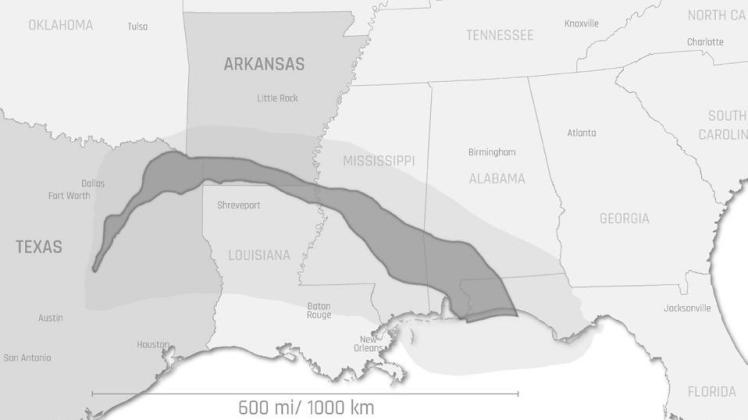
East Texas sits in the prime seat of a geological area called the ‘Smackover Formation’. According to the U.S. Geological Survey (USGS), the Smackover Formation is “a relic of an ancient sea that left an extensive, porous, and permeable limestone geologic unit that extends under parts of Arkansas, Louisiana, Texas, Alabama, Mississippi, and Florida. It dates to the Jurassic geological time period and is known for its rich deposits of oil and bromine. In recent years, the Smackover Formation has also gained attention for potential lithium in brines– high-salinity waters associated with deep salt deposits.”
This formation is around 2,000 feet deep in the northern parts, and 22,000 feet deep in southern regions. It was named after an Arkansas town where they first drilled and produced ‘Smackover Limestone’ in 1936.
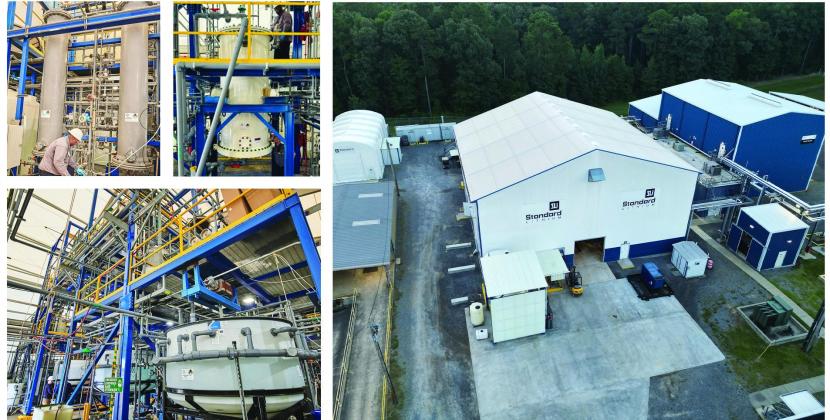
Smackover Lithium is one of the companies interested in mining lithium under East Texas. They’re a joint venture between Standard Lithium and Equinor, currently operating on the company’s flagship projects: the Southwest Arkansas Project and Phase 1A Project. According to Standard Lithium’s website, these are located in southern Arkansas, near the Louisiana border.
So, what would these types of projects mean for East Texas? There has been equal push and pull for lithium mining, an outcry of concern about what this would do for the environment, people’s land, the economy, and more. Just like in any discourse about energy, there’s a list of pros and cons. Lithium is primarily mined for recharge- able batteries. This means that most electronics we use every day rely on lithium in some shape or form. The need for lithium has been slowly increasing as electric vehicles are also pushed on the market, due to it being more energy efficient.”
“The USGS says that the U.S. relies on imports for more than 25% of its lithium and has a low-end estimate that the “five-million tons of lithium present in Smackover brines is also equivalent to more than nine times the International Energy Agency’s projection of global lithium demand for electric vehicles in 2030.”
Andy Robinson is the President of Standard Lithium and has a PhD in Geochemistry from the University of Bristol. He also has 20 years of experience as a geoscientist and worked on a range of projects in power and energy sectors in Europe, Africa, and in North and South America. We had a chance to speak with him about the process of lithium mining and its effects.
“Historically, there’s been two ways that lithium is mined,” Robinson explained. “There are evaporation ponds– which are very, very large ponds and may cover hundreds and thousands of acres. They pump the brine to the surface and move it from pond to pond over several months. During that time period, they evaporate the water in those very large, very shallow ponds. It’s a very large, but low-energy input processing technique. You’re relying on the sun to do all the work for you, so it can take months.”
A study done by Columbia Climate School at Columbia University in New York stated, “To extract one ton of lithium requires about 500,000 liters of water and can result in the poisoning of reservoirs and related health problems.”
Robinson explained why evaporation ponds are not the method they would choose for East Texas, “You literally need thousands of acres of flat ground to build evaporation ponds and that does not exist in East Texas or Southern Arkansas. And the climate does not allow for evaporation ponds. It’s humid in East Texas– the Gulf Coast in general. Evaporation rates are low and it rains. That’s why we need to use alternative technology.”
The other method of lithium mining is known as Direct Lithium Extraction (DLE). It does not require the giant evaporation ponds and, according to the International Lithium Association, the production has much lower water and carbon footprints, and the chances of damage to local water sources are considerably less.
Unlike the evaporation ponds, DLE uses various technologies to extract lithium from brine, and it is done so in a matter of hours or days. It is considered much more environmentally friendly due to the lower land and water requirements and often achieves higher lithium recoveries.
“There are some well pads that are required, but it would be similar– in terms of a footprint– to a small oil and gas type operation,” Robinson said.
He went on to explain this parallel, “At the core of what we do is that we have a fluid resource in the ground in a geological formation– very much the same as oil and gas. It’s just that our resource is salt water. We drill a small number of wells, exactly the same as oil and gas as well. Same rigs, same people, same technology. For all intents and purposes, it’s very similar to an oil and gas operation– except we don’t produce any hydrocarbons.”
Smackover Lithium has been working on getting a project started in East Texas for the past four years. Robinson said they’ve drilled three exploration wells in East Texas and they’re still calculating the data, but so far, they see “potentially world-class deposits”.
Robinson also emphasized their thoughts for the people of East Texas, “We’re working with landowners and we’re very respectful of what land means to people in East Texas. The fact that so many of these ranches have been passed down for generations or a first-time landowner who has worked so hard to have that– we appreciate that kind of intrinsic value that the land has. We want to be conscious and careful by design to make sure we’re not disturbing any of the shallow surface groundwater aquifers.”
While they are in talks with East Texas leaders, Robinson said they are still several years away from knowing exactly where mining infrastructure would go. In the future, they wish to discuss the project with the public, hold Q&A’s, and forums.
In Southern Arkansas, Standard Lithium has been very community-involved by building a local workforce, helping workforce developmental programs at local colleges, and dedicated time and money to the K-12 STEM programs in schools around the area.
“We want to earn the trust of the community because we want to be a part of the community,” Robinson said.
“We’ve been very transparent in Southern Arkansas and we want to do the same thing in East Texas.”