 The Howard Home, owned by Rick and Julie Hagler, was built in 1942 in the forgotten town of Leigh, Texas, located between Karnack and Uncertain, Texas.
 Rick and Julie Hagler saved a piece of the original wallpaper when they remodeled the home.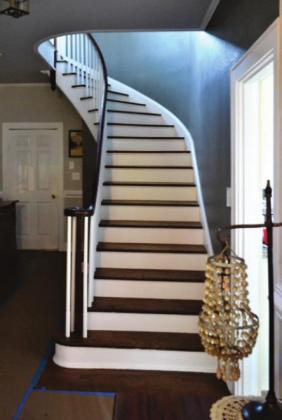


 Musician Rick Hagler, former bassist for Percy Sledge, performs with his current band, Captain Joe, at a summer tent party in the yard of his 1942 plantation home.


Inside This Old House
It’s the time of year most people in Northeast Texas spend time on the water. While there are many lakes in our corner of the state, there is no other like Caddo, which sits right on top of the Texas-Louisiana border. Many people from Cass County own cabins there and drive the 45-minute commute each weekend throughout the summer.
Hailed as the only natural lake in Texas, over 20,000 acres of land was designated the Caddo Lake Ramsar Wetlands in 1993. Thanks, in part, to local musician Don Henley and The Caddo Lake Institute founded by him, the area was the 13th of 26 United States sites to be designated since the Ramsar Convention to Protect Wetlands of International Importance was established.
A portion of that land is now deemed the Caddo Lake National Wildlife Refuge, between the small towns of Karnack and Uncertain, where Longhorn Army Ammunition Plant was established in 1942. Lyndon Baines Johnson was a young Congressman at the time and persuaded the Army to build the plant in the isolated rural area adjacent to his wife Lady Bird’s hometown of Karnack, where her childhood home is still a tourist draw.
Longhorn started off producing trinitrotoluene (TNT) and spent 55 years manufacturing a variety of munitions and incendiary devices. Comprised of 451 buildings at its peak, the plant was contracted out to Thiokol Corporation for rehabilitation to produce solid propellant rocket motors.
On September 9, 1988 Longhorn played a significant role in history when it was the site where the first U.S. missiles were destroyed as a part of the U.S. and Soviet INS (Intermediate-range Nuclear forces) treaty, the beginning of the end of the nuclear arms race between the world’s atomic age superpowers.
In 1997, the Army declared the Longhorn facility to be “in excess of its needs” and the following year the U.S. Fish & Wildlife Service requested that the site be transferred to them for the purpose of establishing a national wildlife refuge. In the ensuing years, portions of the Longhorn lands were declared an Environmental Protection Agency Superfund site and extensive remediation was undertaken to remove chemical wastes and other hazards while the Service began focusing on the management of the habitat for the conservation and protection of the migratory and resident waterfowl and neotropical migratory birds that utilized these important wetlands.
In September of 2009, the Caddo Lake National Wildlife was opened to the public for wildlife-dependent recreation. The Plant guardhouse was moved to the visitors’ complex where it was given a new life greeting refuge visitors and deepening their understanding of the importance and value of wetlands at Caddo Lake and throughout the world.
The Big Cypress Bayou cuts through the land, where Karnack and Uncertain meet the old community of Leigh, Texas – once called Antioch – at the intersection of Farm roads 134 and 1999. Centuries ago, the site was the location of a large Indian village, and many artifacts have been found to support this claim.
It was here in the early 1840s, John J. Webster built a plantation home, Mimosa Hall, which is still standing and privately owned. In 1901 Antioch was renamed Leigh, after the wife of John W. Furrh, who owned land on the railroad when the post office opened. Rev. James Patterson built a restaurant and a general store on land adjoining the railroad.
In 1904 Leigh had one school with five White students and four schools with 297 Black students. By 1914 the community had a population of fifty, three general stores, two cotton gins, a drugstore, a blacksmith shop, and telephone service. After attaining a peak population of 126 in the 1920s, Leigh declined to 100 in 1930, when it had a church, two schools, and three businesses.
Today the town has been swallowed by Karnack. A couple of churches, an old cemetery, a dilapidated old brick store and a few homes are all that exist of Leigh, which isn’t far past the Big Cypress bridge on Highway 43, that countless Cass County daredevils have jumped from. The riverbanks are dotted with weekend cabins and vacation homes owned by people from all over East Texas.
Webster’s Mimosa Hall and one-hundred and fifty acres that went along with it was deeded to Douglas V. Blocker within a partition deed in 1932. Blocker continued to own the property until 1984 when he sold it to Michael Howard.
While Ladybird’s home and Mimosa Hall are popular tourist attractions, this is a photo essay of the third plantation in Leigh. Built by the Howard Family in 1942, it is now owned by Rick and Julie Hagler.
Rick played bass for Percy Sledge from the 1990s until Sledge died in 2015. He currently plays bass for the Captain Joe Band, fronted by Wade Tyson of Atlanta, Texas, James Williams, also of Atlanta, on drums, and Gary Paul Bertrand of Louisiana on guitar.
The Hagler home, built in the Greek Revival tradition of Mimosa Hall, sits amid a sprawling cattle ranch. The property was the site of a June tent party, complete with food, music and plenty of perfect photo opportunities.