
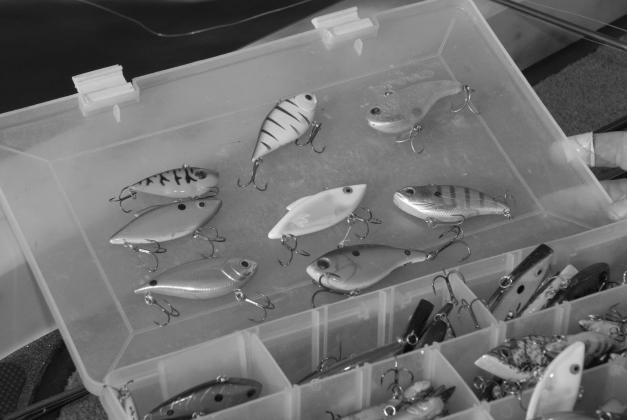
 Lipless crank baits and other styles of hard body lures come in assorted colors. It’s always best to match the hatch by throwing colors that simulate the primary forage on which the bass are feeding.Crawfish patterns like red,orange and brown heavy favo
 Swim jigs, bladed jigs and spinnerbaits are ideal for throwing around shallow cover when bass are in the mood to chase. Shad or bluegill color patterns are hard to beat in clear water situations. (Photo by Matt Williams)
 Anglers can do themselves a favor — and save some money — by sticking to the basics when it comes to choosing soft plastics color. Green pumpkin, red bug and watermelon typically cover most of the basics in clear and stained water. (Photo by Matt Will
The Color Code
Few topics in bass fishing muddle the water with anglers more than color does. Some might believe their bait stash can’t be complete unless it includes every color under the sun.
I used to be one of those guys whose tackle store adventures rarely ended painlessly. Rather than sticking with what I already knew would work, I would invariably get sucked in by all the eye candy and walk out with a few lures or plastics that never caught squat.
Years spent fishing along with countless conservations with some of saltiest bass pros on the planet finally changed all that. Translation: Stick with the basic colors and you’ll catch more bass. It’s just that simple.
Bass pro Mark Rose of West Memphis, Arkansas has ever been one to get sucked in by the color vacuum, particularly when it comes to soft plastics. Rose says he sticks with what experience has taught him.
“Choosing soft plastic colors can confuse you if you allow it to,” Rose said. “There are ton of different colors under the rainbow, but you don’t need them all to catch bass. The flip side to that is I definitely think color matters. I don’t think you can use one color to suffice for everything, but you definitely don’t need them all.”
The same is true of crank baits, topwaters, spinnerbaits and frogs. There is no single color that will work best in every situation, but there are a handful that will work better than others most of the time. Others may rarely work at all.
The best hard body colors are those that simulate the primary forage available in a given reservoir system. Shad, sunfish and crawfish are the main sources of food on most Texas lakes.
Chrome, pearl, silver and white are ideal for simulating shad. Chartreuse, greens and and blues look like sunfish, while brown, orange and red simulate crawfish.
Former Bassmaster Classic champ Tommy Martin of Hemphill has been chasing bass all over the country for decades now. He’s learned from experience that one of the best ways to choose bait colors is to match the hatch.
“With crankbaits, topwaters and vibrating plugs it is always best to choose a color that best matches what the fish are feeding on,” Martin said. “Try to learn the different types of forage in a particular lake. Once you do that you can usually get by with just a handful of colors.”
Crawfish are a staple food source in late winter and early spring. Bass feed on shad and bluegills yearround.
“Black can be really good color on topwaters like Whopper Ploppers and frogs, especially in low light conditions,” Martin said.
Martin keeps things even more simple when it comes to picking soft plastics.
“I can live with three colors — green pumpkin/ chartreuse is hard to beat, especially during the spring,” he said. “Other than that I’ll throw a lot of red bug and junebug. I also use blue fleck quite a bit.”
The same is true of spinnerbaits, swim jigs and bladed jigs. White and chartreuse/white are longtime favorites in spinnerbait arenas. As swim jigs and bladed jigs go, white and bluegill colors like green pumpkin/blue/green or watermelon are good choices. Another popular color is black/blue, particularly in stained water conditions.
Todd Driscoll of Brookeland is another hardcore angler who has learned not to overthink things when it comes to lure color. The Texas Parks and Wildlife Department fisheries biologist claims he spent years caught up the color trap before he finally learned to simplify. Driscoll likes to catch bass any way he can, but flipping tight to cover with plastics and jigs is his favorite.
“I went through that phase of going through 10 different colors trying to get the fish to bite, but after 20 years of fishing I truly believe the whole color deal is a bunch of bull,” he said. “When I flip I always stick with three basic colors — black/blue, some form green pumpkin and watermelon. My favorite beaver color overall is a green pumpkin/black blue laminate by Reaction Innovations. It’s called Tramp Stamp.”
Driscoll says he bases soft plastic color selection on water clarity and mental confidence more than any other factors. Darker colors get the nod in water with some color to it. He thinks translucent colors work best in clearer water.
The same is true of crankbaits. He likes chartreuse/ blue or black back if it’s dingy, sexy shad if its normal and more of a clear shell with a little bit of color to it if the water is really clear.”
Driscoll narrows down his color choices even more when it comes to surface lures like frogs and the Whopper Plopper. White and black are his mainstays.
“There are times when any color would probably work, but I always throw what I’ve got the most confidence in,” he said. “I tend to prefer black early in the morning, when it’s cloudy or the water is little off color. If it’s sunny I’ll throw white or bone.”
Major League Fishing pro Brett Hite of Phoenix, Arizona, is well known for his prowess with a bladed jig, but can catch them from top to bottom on other lure styles, too. Experience has taught the Hite to keep things simple and not to over think when it comes to making color choices. However, he may step out of the box on occasion when fishing in gin clear water.
“Fish can see baits really well in clear water,” Hite said. “They tend to be a lot more finicky, and bait colors can make a big time difference. Small color tweaks such as going to a green pumpkin/blue flake instead of green pumpkin can at times make a big difference in the number of bites you will get.”
Tennessee pro Brad Knight says he has never been one to put much emphasis on color. He thinks it’s more important to put baits in the right spot with the proper presentation.
“I don’t put a lot of thought into color -- I never have,” Knight said. “If you allow yourself to get caught up in the color deal, you’ll wind up with so many different shades of plastics that you can’t keep up with them and keep them organized. Personally, I’ve never been a situation where one specific color would really outshine another one. A lot of people believe that, but I don’t. I’m pretty simplistic about it.”
Knight said he relies more on green pumpkin and black/blue colored plastics the majority of the time when he’s flipping or fan casting with soft stick baits.
“There might be a couple of different situations where some different colors might work a little better, but I’d say that 95 percent of my stuff is going to be green pumpkin or black/blue,” he said. “You can’t hardly go wrong with those two colors, no matter where you fish.”
In muddy or brackish water, Knight likes black/ blue over other colors because it tends to stand out better. In water that is slightly stained to moderately clear he says he will almost always go with green pumpkin. The exception is Lake Okeechobee in Florida, where the bass have a thing about junebug plastics.
Another situation where Knight might vary his color is when soaking tube baits for smallmouths up north, where the predominant forage is gobies. “There have been a million smallmouths caught on green pumpkin tubes but there might be times when something with a little flake will work a little better.”
When it comes to swim baits, Knight sometimes takes an approach that is somewhat different from the masses. He says he prefers a pearl or white hue in stained or muddy water over darker colors, mainly because he thinks it stands out better and simulates the natural color of shad.
“A lot of people will switch to a chartreuse lure in muddy water, but I’m directly the opposite,” he said. “Think about it. When you catch a bass out of muddy water, its really pale in color because of the lack of sunlight penetration. The same thing happens with the shad. To me, the white shows up better in dirtier water and it matches the forage better.”
Choosing the best lure colors for bass fishing isn’t rocket science.
The best advice is to keep things simple. Learn the forage in your lakes, match the hatch and focus more on putting your baits where the fish live.
You’ll catch more that way.
Matt Williams is a freelance writer based in Nacogdoches. He can be reached by email, mattwillwrite4u@yahoo.com.