

Cass County mules aid in WWII
The information and pictures were provided by Pat Tomberlain who is a member of our Cass County Genealogical Society. Pat is a retired history teacher from the Atlanta ISD. He is a history scholar who brings local history to life and connects it to world events.
During World War II there was a critical shortage of motorized equipment. In an effort to overcome these shortages, there was a return to the use of horses and mules to move heavy, earth-moving equipment.
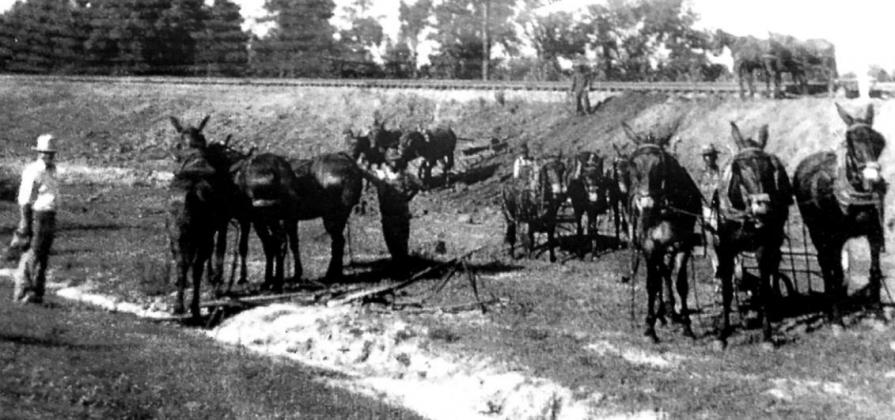
Mr. Paul Baker from Douglassville was awarded a government contract to widen the railroad bed so that there was enough room for two railroad tracks leading into Ft. Polk, Louisiana. Mr. Baker brought 47 mules to the job. Along with the mules, there had to be mule skinners (drivers) and many of these were from Cass County.
Although this was the last largescale project for Mr. Paul, he brought these mules back to Cass County and built housing pads at Red River Army Depot.
Later, some of the mules were sold to Mr. Clyde Clements of Atlanta to work on his Red River bottom plantation. With his remaining mules, he worked on the side slopes of the DALLAS – FT. TURNPIKE. This is probably one of the last times that mules were used on turnpike construction.
The availability of these 47 mules, as well as many more horses and mules, was the result of an outstanding breeding program carried on by the farmers in both Morris and Cass County, especially in the area between Naples and Douglassville.
In Naples, a livestock sale barn was constructed and operated by H. J. Vissering--Pat Tomberlain’s grandfather. In Douglassville, a livestock sale barn was operated by the Morriss family. The name Caldwell (Po Boy) Morriss cannot be mentioned without memories of the Douglassville Sale Barn coming to mind. Both barns were constructed in the 1930s.
The idea of the Naples Livestock Sale Barn had its beginning on the H. J. Vissering farm and ranch in the area of old Wheatville. Like most of Wheatville’s businesses, the sale barn eventually moved a short distance to the new town of Naples to take advantage of a new railroad track.
The Vissering Sale Barn was built near the present-day overpass in Naples. The overpass extends U.S. 77 that comes from Douglassville over the railroad track and connects it to U.S. 67.
The sale barn had catch pens next to the railroad tracks for loading and unloading stock.
The barn lasted only a short time after Mr. Vissering was sent to Dallas by the local doctor, Dr. Smith, and was diagnosed with cancer. The doctor in Dallas’ exact words were, “Papa, school is out.” Mr. Vissering lived for exactly 10 days after this.
With Mr. Vissering gone as the driving force, the barn soon closed but not the horse and mule trade.
The jack services were continued on the Vissering farm because local farmers still did most of the farm work with horses and mules. Coming out of the Great Depression, few farmers could afford to buy tractors.
Mr. Vissering’s influence on the mule breeding program continued for many years after his death. Remember, mules cannot reproduce. A mule can only be created by crossing a jack donkey with a female horse. Mr. Vissering brought some of the best jack donkeys to the area.
The last local livestock sales barn in operation was in Douglasville from the 1930s until the mid-1960s.
A SPECIAL NOTE TO ALL OF OUR READERS
If you are having trouble with your Genealogy or just want to know who your Great Grandfather was and what he did The Cass County Genealogical Society might be able to answer your questions.
Or if you have an interesting or humors tale about your family, or a little-known tidbit about our local history that you would like to see recorded for posterity, please contact its at:
C. C. G. S.
P. O. Box 880
Atlanta, Texas 75551,
E-mail us at evanjevans@yahoo.com ,
Call us at (903) 796-3081,
Or just visit us in the Genealogy and History Section on the Second Floor of the Atlanta Public Library.