
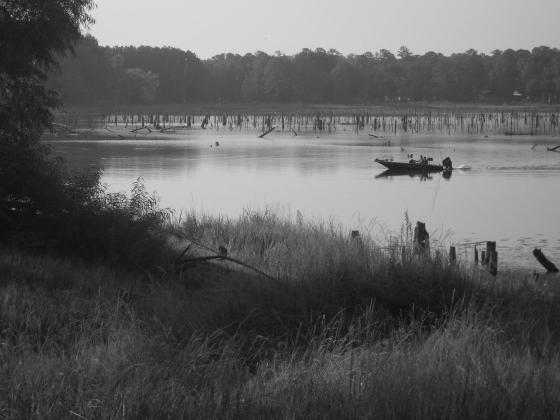
 Extended periods of low water level can hamper accessibility while at the same time turning a tired lake into a new one. Several reservoir in Central Texas the Hill Country are experiencing historic lows right now. (Photo Matt Williams)
 New growth terrestrial cover flooded by several feet of water provides young-ofthe- year game fish and forage such as sunfish and shad good places to hide from predators.This usually results in extremely high recruitment among one or more year classes of
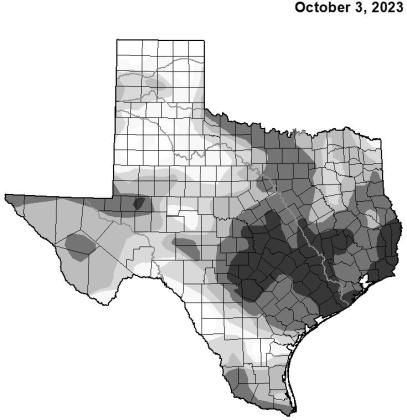 (Texas Drought Monitor) The Texas drought monitor graphic depict the various stages of drought currently in play across.The darker areas depict areas that are in severe, extreme or exceptional drought. Conditions are particularly bad in Central Texas and
The Lowly State of Texas Lakes
Prolonged drought is no stranger to Texas. It seems like the faucet always shuts down in one portion of the state or another every year, and 2023 has been no exception.
Despite a few isolated showers in recent weeks, much of Texas is still in some form of drought with no real relief in sight. Some regions have been abnormally dry for years.
A quick check of the U.S. Drought Monitor showed dry conditions to be the most widespread, and severe, in central and eastern portions of state. Dozens of counties within a wide swath spanning as far south as Refugio County and as far north as Wilbarger County on Texas/Oklahoma border are in red or brown zones depicting severe, exceptional or extremely dry conditions. The path extends east to west from the Pineywoods to the western edge of the Hill Country as far as Mason and Bandera counties.
Signs of the Times
Signs of drought come in many different forms. Among the most obvious to the naked eye are parched landscapes starving for moisture and low water levels on public reservoirs and private stock tanks.
Low water is nothing new on the heels of a hot, Texas summer, but the extreme lows currently being witnessed on some reservoirs are anything but normal.
A few Hill Country reservoirs are extremely low and inching lower each day, according to Patrick Ireland of San Marcos.
Ireland is a Texas Parks and Wildlife Department inland fisheries biologist who rides shotgun over more than a dozen lakes in the San Marcos/Austin district. The biologist said several of the lakes under his watch have been significantly low for months, mainly because day-to-day water usage demands and evaporation continue to outpace inflow.
One of the lakes — Canyon Lake — is well below its historic low.
Located near New Braunfels, the Canyon cracked its all-time low of 892.70 feet above sea level in late August. The 8,300acre Comal County reservoir has since dropped more than two additional feet. On October 12, the lake was at 18.71 feet below conservation pool, according to waterdatafortexas. org.
The low water has made many boat ramps unusable and stressed lakeside businesses dependent on recreation and even exposed some mysterious caves and other geological features along the lake’s rocky shoreline that haven’t seen sunlight for decades.
Ireland said four other Highland Chain lakes in his district have fallen low enough to cause problems and spark concerns about the future with no rain to fill them back up.
Lakes Buchanan and Georgetown are nearing historic lows. And Lake Travis north of Austin is only only 35.4 percent full or 52.70 feet below full pool, resulting in the closure of all public boat ramps, Ireland said.
It’s hard to imagine the 18,600-acre Colorado River impoundment falling any lower, but it has happened three times. Travis hit its all-time low of 614.18 (66.82 feet low) in 1951. It also fell to 615.00 in 1963 and 618.00 in 2013.
Another Austin area lake — Decker Lake — has dropped low enough that the city recently opted to close the impoundment to power boat traffic out concerns for boating safety, Ireland said.
Bottomline: Significant rainfall can’t come to the region soon enough.
“It’s getting bad,” Ireland said. “We’ve been in extreme drought in parts of Central Texas for more than two years now. If we go into another year like this we’re going to be in serious trouble. We’ve got a our fingers crossed hoping for rain.”
Former TPWD fisheries biologist John Tibbs knows the feeling. Tibbs retired from TPWD in August after 23 years as supervisor over nearly a dozen lakes in TPWD’s Waco district.
Several of those Central Texas impoundments have dropped well below full pool with the years-long drought. Among the hardest hit is Lake Belton near Temple, a 12,300-acre Bell County reservoir that some regard as one of the best smallmouth bass lakes in the state.
Belton was 55.1 percent full or 18.79 feet low and falling as of October 12. The current mark is 575.21 feet above sea level, more than seven feet below the previous all-time low recorded in 1978, according to the U.S. Corp of Engineers Lake Belton website.
“I certainly never saw it lower in the 23 years I was there — not even close,” Tibbs said. “It’s low enough that several of the big complexes of artificial fish structures we put out in the lake are now exposed. There’s just a trickle of water going under the Highway 36 bridge at the upper end of the lake. That’s historically where we did our fish stockings.”
The List Goes On
Several more Central Texas and Hill Country lakes are a long way from being full. Among them are lakes Waco (11.67 feet low) and Stillhouse Hollow, a 6,400-acre lake about five miles west of Belton. Stillhouse is at an all-time record low of 19.13 feet below conservation pool, according to the U.S. Corp of Engineers Stillhouse Hollow website. Lake Medina is 87.19 feet low, or 3.9 percent of full capacity; E.V. Spence, 46.62 feet low; and Lake Coleman, 8.43 feet low.
The list of Texas lakes hurting for water goes on and on.
Down south, Choke Canyon is at 26.4 percent capacity; Falcon, 8.3 percent capacity. Out west, Lake Amistad is about 32 percent capacity; O.H. Ivie, 30 percent capacity; O.C. Fisher, 2.1 percent capacity; and J.B. Thomas, 20.5 percent capacity.
Last summer’s relentless heat and drought took a lesser toll on East Texas lakes, but some are still noticeably low.
Toledo Bend is at 4.13 feet low; Sam Rayburn, 5.42 feet low; Livingston, 3.86 feet low; Limestone, 3.86 feet low; Nacogdoches, 3.15 feet low; Fork, 2.31 feet low and Cedar Creek, 3.73 feet low.
In Fannin County, the lack of moisture continues to stifle the opening of Texas’ newest public reservoir, Bois d’ Arc Lake.
The North Texas Municipal Water District originally hoped to open the 16,600acre reservoir to boat traffic in 2023 once it filled to about two feet below conservation pool. It’s not even close at this point.
Bois d’ Arc is currently about 6.91 feet low and 71.8 percent of full capacity. The lake did reach 80 percent capacity in June, but the water level has been on a free fall ever since. It’s anybody’s guess when Bois d’ Arc might finally open for fishing and boating, but it doesn’t seem likely that it will happen in 2023 TPWD fisheries biologist Dan Bennett of Pottsboro is among those who are anxiously awaiting the opening of Texas’ first major reservoir since 19,000-acre Lake O.H. Ivie in 1990. Bennett says plenty of anglers are excited about fishing at the new northeast Texas reservoir, but says the delayed opening isn’t necessarily a bad thing.
“The longer it stays closed the bigger the fish are going to get it,” Bennett said. “That will enhance the fishing experience for anglers once it does open. There will definitely be more quality-sized fish available to be caught.”
Looking Ahead: Tired to New
Grim as all of the talk of low water may sound, there is a silver lining to it all. It’s called the “new lake effect.” Here’s what happens: During extended periods of low water, large portions of the lake bed normally covered by water are exposed to direct sunlight.
Sunlight spurs the gradual growth of grasses, weeds, bushes, trees and other forms of terrestrial vegetation native to the landscape. The longer the lake remains low, the thicker and more widespread the new growth vegetation becomes.
When water levels do rise, the new growth terrestrial vegetation that sprouted during the low water period is flooded. This pumps in rich nutrients that act as liquid fertilizer to promote a boom in plankton and aquatic vegetation growth benefitting everything from forage fish populations to top end predators like bass, catfish and crappie.
The jungle of flooded cover also provides young-of-the-year game fish and forage such as sunfish and shad good places to hide from predators. This usually results in extremely high recruitment among one or more year classes of fish, ultimately bringing new life to old or tired fisheries as the fish mature.
The new lake effect has been documented on a number of Texas reservoirs over the years, and the stage is set for others bust loose with good fishing in the future.
Those reservoirs just need water to make it happen. In some cases, a whole lot of it. ----- Matt Williams is a freelance writer based in Nacogdoches. He can be reached by e-mail, mattwillwrite4u@yahoo.com.